
Vendor pricing checked in November 2026. TalentHR is our product, and we list it first.
The best Zoho People alternatives in 2026 are TalentHR if you need a lightweight HR solution that’s even more affordable than Zoho People, or Gusto if what you’re struggling with is payroll in the United States. Alternatively, you can use Rippling if what you really wanted was a solution to deal with frequent tax filings and automations. Or, Personio if what you actually wanted was a European-centered software solution, or BambooHR if what you wanted was an established, reputable HR solution that many users have experience with.
Zoho People: Eight questions to stay or go
Zoho People is the HR solution from Zoho, the company behind one of the most-adopted CRM solutions globally.
Zoho distributes People as a standalone HR solution or as part of its broader Zoho One platform. Zoho People handles core HR tasks like onboarding, time off, and keeping employee records, but it’s easy to see why a company would want to move beyond it. It might lack a modern UI that non-HR users feel comfortable with. Since Zoho has not made HR its core business, the interface can look clunky or out of date. It might also fall short on payroll, and a support team spread across dozens of Zoho products might not be able to drill deep enough on edge cases.
That said, you might have entirely different reasons to consider migrating away. This is a quick stay-or-go test to help you decide.
- You’re using only Zoho People within Zoho One
- You actually needed Zoho Recruit and added Zoho People because you noticed it’s free
- You need your platform to solve international payroll
- You already have a payroll provider and need your platform to integrate with it
- You’ll need customer support during specific payroll periods, like around the holidays
- You care about keeping your data in a single data center, because a client requests it as part of an agreement
- You need a solution that keeps adding features to the roadmap at a steady pace
- You need clear modules that a non-HR person can handle
If you answered “Yes” to four or more of the eight, you can consider moving on from Zoho People.
None of these questions imply that Zoho People is not a quality solution. They’re a way to understand where the product’s focus is and where your focus as a company might be instead.
Zoho People’s biggest advantages and 2026 pricing
Zoho People is a core HR solution that’s easy to speak positively about. It’s part of Zoho One, Zoho’s suite for SMBs. Zoho One includes more than 50 software options, and its All Employee plan runs $37 per employee per month, billed annually.
But Zoho People on its own (not as part of Zoho One) is also cheap. There’s a free plan for up to three users, and the Workforce tier, which Zoho calls its most popular, runs $5 per user per month, billed annually ($6 billed monthly). These are 2026 prices advertised on their website.
One additional positive feature is the wider ecosystem the tool belongs to. If your sales reps are already adept at Zoho CRM, expect them to feel confident requesting time off in Zoho People. If your HR team already runs Zoho Recruit, many users online claim that connecting them takes, in their words, just about two minutes.
Attendance is the other real strength. Zoho People handles shift scheduling; the Workforce plan adds attendance tracking and timesheets with overtime compliance, and Zoho lists check-ins through biometric devices or a facial-recognition kiosk at the front desk among its attendance features, which is a lot of attendance depth for the price.
If you stay: how to customize Zoho People correctly
If you ran the scorecard and landed on two or three “Yes” answers while the rest of the questions didn’t even sound like your case, you might consider staying with this solution. Rather than migrating, you may just need to configure the solution so it plays to your advantage. Consider these two steps:
Get the most out of the integrations. Connect Zoho People to Zoho Recruit, their ATS. When you integrate two HR solutions, the goal is to cover the full employee lifecycle in one pipeline: from the moment someone sends a resume, through hiring and onboarding, all the way to offboarding. That single integration goes a long way toward solving a central headache that probably got you here, which is data sitting in silos.
Check their APIs. Opinions on the Zoho API are mixed, to put it mildly, but see how far Zoho People’s API methods get you. You may be able to add payroll through the API and skip migrating altogether.
But you might still decide to go.
Zoho People Alternatives and Competitors for SMBs
Say you scored at least four “Yes” answers from the questionnaire and you reckon you need to move on to something else. These are five Zoho People alternatives for SMBs in 2026 to consider. If you’re an Indian company leaving Zoho People mainly for statutory payroll and compliance, this list won’t cover that well, so look at India-focused HRMS vendors instead.
TalentHR
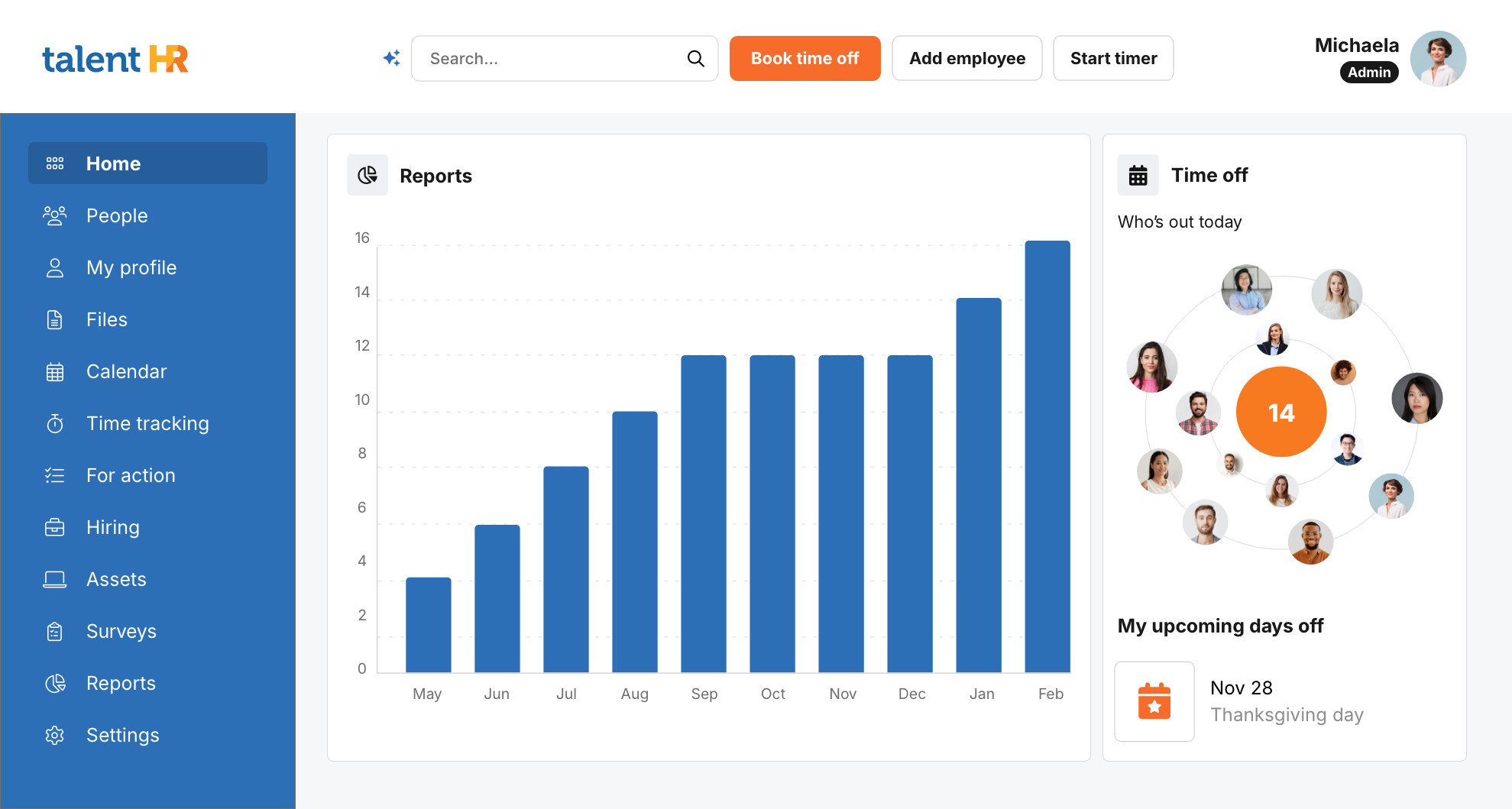
TalentHR is a nimble, affordable, easy-to-set-up HRIS that lets companies manage core HR features on a free plan. Set it up in a few clicks to handle onboarding and employee records, then move to the Premium plan for time off and attendance tracking and benefits administration. Companies can add features on the paid tiers as they discover they need them.
Like Zoho People, TalentHR is conveniently priced, and its billing is transparent. This means you can read it from the pricing page and forecast what you’ll spend when the company goes from 50 to 500 employees. In 2026, moving off the free plan starts at $2 per user per month, billed annually ($2.40 billed monthly), less than Zoho People’s cheapest paid tier.
With TalentHR, you keep the HR features of Zoho People and add an ATS; that missing piece that’s part of Zoho Recruit. To migrate, companies can import a .CSV file into TalentHR. New clients get an always-on-the-move roadmap: TalentHR recently shipped 360° performance reviews.
TalentHR connects to thousands of apps through its integrations with Zapier and Make.com, and non-HR staff can pick it up. Recent additions include workflow automations and AI features that make a difference for non-HR users, like drafting recruitment ads you can then publish with a click. Companies can also connect their current payroll provider through Zapier or Make.com.
Keep in mind that, unlike Zoho and its suite, TalentHR is an HR platform. Anyone leaving Zoho One should remember this is not a CRM. If you answered “Yes” to the questions above, you already knew that.
BambooHR
BambooHR is a well-known HR software solution that offers an extra segment of payroll services. Its reputation comes from its popularity: a lot of employees have applied to jobs through its ATS, which makes it a name that builds trust in your employer brand.
It covers every branch of HR you could cover with Zoho People: time off, onboarding, the ATS itself. The difference is how the price is communicated. We took Zoho People’s prices off their website, which sounds trivial until you notice not every vendor does it. On their pricing page, BambooHR asks users to request a quote. But the plan cards do list a Core plan starting at $10 per employee per month for companies over 25 employees, twice the amount charged by Zoho People’s Workforce plan, and smaller teams pay a flat rate starting at $250 a month.
That can still make sense for a company that wants one HR ecosystem and a payroll platform bundled with BambooHR. The watch-out is what you give up: knowing the exact price beforehand, since add-ons need a quote.
Gusto
Gusto is the option if the 8 questions above pushed you toward the payroll path.
Gusto is a payroll-first solution focused on the United States, well regarded by small and medium companies. It calculates payroll, runs it automatically, files the W-2 and 1099 at year-end, and takes the headaches out of the payment workflow. It isn’t an HR solution the way Zoho People is, though it covers onboarding, benefits administration, and time and attendance.
Gusto charges higher rates because the HR platform sits embedded inside the payroll platform, so you may pay for more than you need. Their site says $49 per month, but you add $6 per person as you grow, which puts the first hire at $55 and scales by $6 per person after that.
Gusto is known for being transparent about fees. Some payroll providers charge per run, and Gusto says every plan includes unlimited payroll runs. The watch-out is that you’re committing to US payroll, and the $49 Simple plan only covers payroll in one state. International contractors are not their specialty.
Rippling
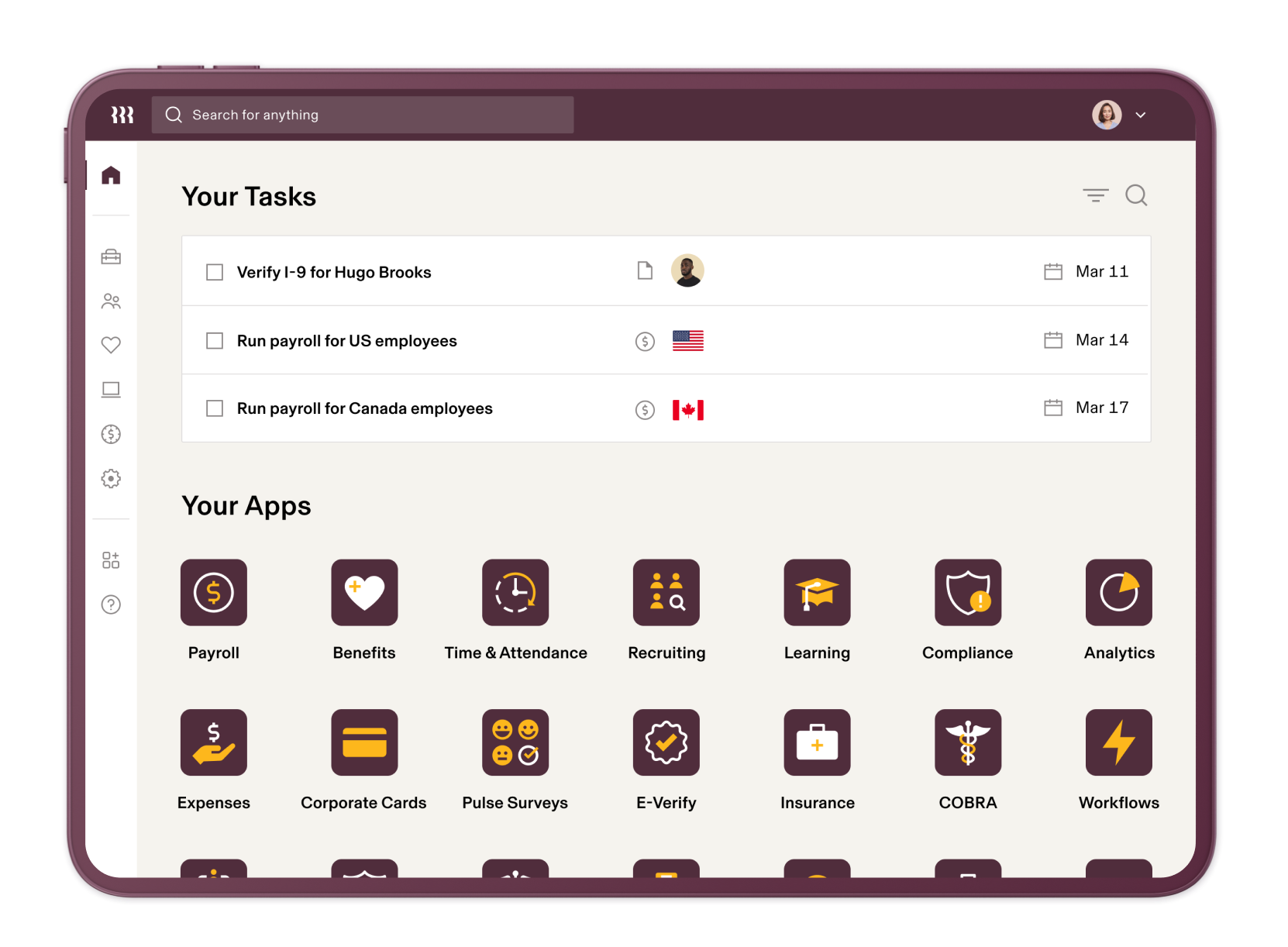
Rippling is a complex, highly customizable HR workflow solution. Companies can build payment automation workflows and asset management systems. For example, with Rippling, a company can confidently fire the right triggers so everyone gets their devices on time once they’re hired. It carries a spend management suite for company and employee expenses, and it runs onboarding and global payroll.
In that sense Rippling combines several products you’d find in the Zoho environment. For example, it’s fair to say that Zoho Expense, a Zoho solution, also covers some features that Rippling solves natively. For a nimble, affordable HR need, Rippling is overkill at the price.
Rippling doesn’t publish detailed pricing. You have to type in your email address to get a quote. They did publish on their blog that the core HRIS platform starts at $8 per employee per month, more than one and a half times Zoho People’s Workforce plan, plus a $35 monthly base fee. If you want the HRIS alone, without spend management, tax filing, deductions, or global payroll, Rippling is not the best spot to shop for it.
If you landed here because you’re trying to solve multi-state compliance, or want to combine IT and payroll in one platform, Rippling is the way to go.
Personio
Personio is a European Union-centered HR solution, based out of Munich, with a broad client base in Europe. It’s one of the brand names that come up when you have to pick a solution that adapts to the EU regulatory framework.
On the questionnaire, one of the questions we wrote was about data centers and data governance. Zoho People runs data centers worldwide, and you can often pick the region, including the EU. By contrast, Personio hosts your data in the European Union by default. If a client deal requires GDPR compliance with a thorough audit trail, Personio may be for you.
On capabilities, you get most of what you already solve with Zoho People. Earlier in 2026, their pricing page listed the Core plan from €7.60 per employee per month. The curious part is the word “starts”, so you can’t know whether it lands there or somewhere else. You have to request a quote to really know how much Personio will cost compared to Zoho People.
Here’s a table comparing the tools:
How to leave Zoho People: migrate users and data
Migrating from one HR tool to another, contrary to popular belief, is relatively straightforward (although it’s never an entertaining chore). This is valid if the new solution has the appropriate migration tracks configured.
So, if you migrate, you’ll probably migrate through a pipeline that has already been tested because many vendors ship export and import features. On export, you download everything in your current HRIS, employee records included, into a CSV. On import, that same CSV fills the blanks in the new solution.
So, to migrate, you need to export all your data categories first.
💡 Since you’re leaving Zoho People specifically, a tip that shows up a lot online is that you are supposed to go module by module when you export. Employees and attendance may need separate exports. Leave balances and shift patterns are the ones that usually need checking, so export balances as of a fixed cutoff date, like the last day of a pay period, and spot-check a few employees before you switch Zoho off.
Once you have your data sources exported, import them into your new solution.
Then keep both running side by side for a while. If you’re replacing single modules first, say payroll, you can switch off the old solution phase by phase. A thought-out path already exists, so you don’t need to be adventurous (fortunately!)
FAQs
Best Zoho People alternatives in 2026?
The best Zoho People alternatives in 2026 are TalentHR if you require a lightweight HR solution that’s more affordable than Zoho People’s paid plans. Gusto if what you’re struggling with is payroll in the United States. Rippling if you want tax filings, automations, and IT management. Personio if you wanted a European-centered solution. BambooHR if you wanted an established name.
Should I stay on Zoho People?
Stay on Zoho People if what you’re struggling with is personalization and customization. If Zoho is part of a broader environment, you may just need to connect your current solution to something else Zoho offers instead of migrating somewhere new.
Zoho People vs BambooHR?
This ends up being a matter of pricing. Zoho People is more affordable and comes with a larger ecosystem. BambooHR is a well-established HR software solution that also covers payroll at an additional expense, and it costs more to run than Zoho People alone.
Zoho People vs TalentHR?
These two compare on how affordable and transparent they are. You can calculate what you’d spend on either, which you should never take for granted across the solutions covered here. TalentHR works out better for a specialized HR solution with a steady stream of features, AI-related ones included.
Does Zoho People include payroll?
No, Zoho People’s HR plans don’t include payroll. Zoho Payroll is a separate product, sold only in some countries, though users report you can integrate a separate provider through the API. Many users online say that the API is outdated, so confirm the specific connection you need works before you commit to it.
How hard is it to leave Zoho People?
Leaving is relatively straightforward if your next solution imports CSV files, which many HR solutions do, because Zoho People can export CSV files you then import into the new system. It depends on your new system and how readily it adapts to an existing data source.
Your decision map
If you like having your current suite and you think you can use other Zoho integrations, then stay with Zoho People. But:
- If you want simple pricing and an always-updating roadmap, go for TalentHR.
- If you want a well-established player that many applicants recognize, you can go for BambooHR.
- If you need to combine IT management, HR, and payroll, go for Rippling.
- If you need US payroll specifically, you can go for Gusto.
- If you want a European Union solution, you can go for Personio.
You can try TalentHR now and start migrating by importing your CSV files.