
The best Workday alternatives for small businesses in 2026 are TalentHR, BambooHR, Gusto, Personio and Rippling. Go with TalentHR if you want nimble, straightforward HR software. Go with BambooHR if you want a well-known ATS solution that’s more specialized than Workday. Go with Gusto if you need to handle payroll in the United States. Go with Rippling if you need a complex solution to handle payroll that’s still lighter than Workday. Go with Personio if you are in the European Union and want a solution directed at that market.
The board-meeting problem: “just get Workday”
It’s easy to imagine why the board of directors, when choosing an HR solution, will tell you to use Workday.
Workday is an established solution that many employees, managers, and decision-makers have interacted with, and many Fortune 500 companies use it. All in all, it’s a generally known solution, and “use Workday” resembles the old adage in-house IT consultants would say: “I purchased IBM, maybe not because I really needed IBM, but because with a vendor like this I can’t be wrong” (and nobody gets fired for buying IBM). For an SMB, Workday might prove helpful, but it’s not advisable to shoehorn it into current operations, even if the board tells you to do it.
It’s easy to verify why it’s not the greatest fit for SMBs. If you access Workday’s homepage and go to products, you’ll see they have products for planning, AI, legal, industry operations, platform, even ERP. The HR solutions page hovers timidly among all these other offerings. This is because Workday is much more than an HR solution. It’s all-encompassing, way broader, and that has been their business plan all along.
It’s also not as widely adopted by SMBs as other solutions. According to technologychecker.io, nearly all of the brands that use Workday are in the 10,000-plus employee range. Boeing, Accenture, Pfizer, Bank of America: They are all massive companies, and they all use Workday. These companies have enormous overhead and a capacity to pay for licenses that many SMBs don’t have or are not planning to have.
In terms of pricing, you need to reach out to sales representatives to know how much Workday costs. If you don’t fill in the form, you cannot know what their price is. There’s a single form for most products, so expect the sales rep to be enthusiastic about selling you a bunch of suites rather than an HR solution.
Is Workday for you?
To understand if Workday is right for you, think of your company’s size. Headcount is a way to see it, for sure. But you don’t need to be a 10,000-person company to consider a solution like Workday. If you’re planning to incorporate a solution to replace spreadsheets, and you’re already mid-sized, you’re way past your spreadsheet threshold.
To know if Workday is for you, answer yes or no to these questions:
- Do you need an HR solution that bundles financial planning and an ERP?
- Are you currently, or planning to be, at more than 10,000 employees under a single workforce management solution?
- Is your organization complex enough that you have a dedicated HR and finance team?
- Is your company enterprise-grade, or financially ready to pay for a plan that will only have a price once you discuss it with the vendor?
- Is your IT team ready to handle integrations that go beyond system work?
If you answer no to most of these questions, then Workday isn’t exactly for you.
Workday alternatives: Solutions that require less admin
Workday is so complex that it requires a lot of admin work even to purchase it. This is how it compares against other solutions.
The main disadvantage of Workday for an SMB is that it’s too much of a solution, so it’s difficult to point out what Workday even stands for. One could call it an ERP, but since they have their own separate Workday ERP offering, even that one is an unfair definition. It’s a whole suite of enterprise solutions that help companies with financial planning, PTO, employee onboarding and hiring, and so on. This is not an inherent problem or a disadvantage, but it can make the commercial offering a bit overwhelming.
All in all, getting Workday gets complicated for SMBs because it’s for enterprise companies that have the resources to handle it, and it solves many complications for them. The thing is, an SMB going for the safe Workday decision might wind up sacrificing too much time that other sleeker, smaller solutions don’t need.
Workday alternatives for small business
Each alternative below replaces Workday for an SMB under one condition.
TalentHR replaces Workday when you want a straightforward HRIS
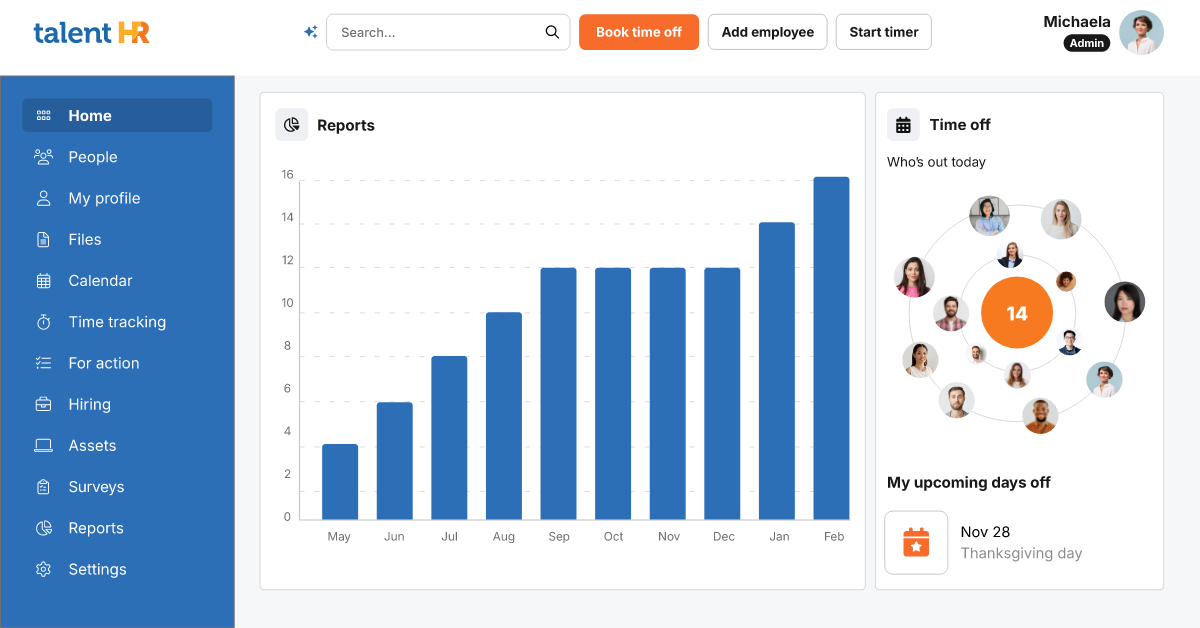
TalentHR is an all-around HR solution, nimble and easy to set up, and that anyone can run. You don’t have to be an HR manager to handle TalentHR. If you notice a piece is missing, it supports integrations by default thanks to its pairing with Zapier.
With TalentHR, it’s easy to get in and easy to get out: companies can migrate employee records by exporting and importing a CSV. That includes any existing Workday data. Also, companies can withdraw from their payroll provider and keep TalentHR, since payroll runs through the built-in integrations.
Pricing is $2 per user per month, published on the site, with a free plan to start. This is not a payroll solution, and it won't get your company as far as Workday can in terms of, let’s say, managing invoices and paying them out, but well, that’s a different scope entirely.
BambooHR replaces Workday when you want a well-known ATS
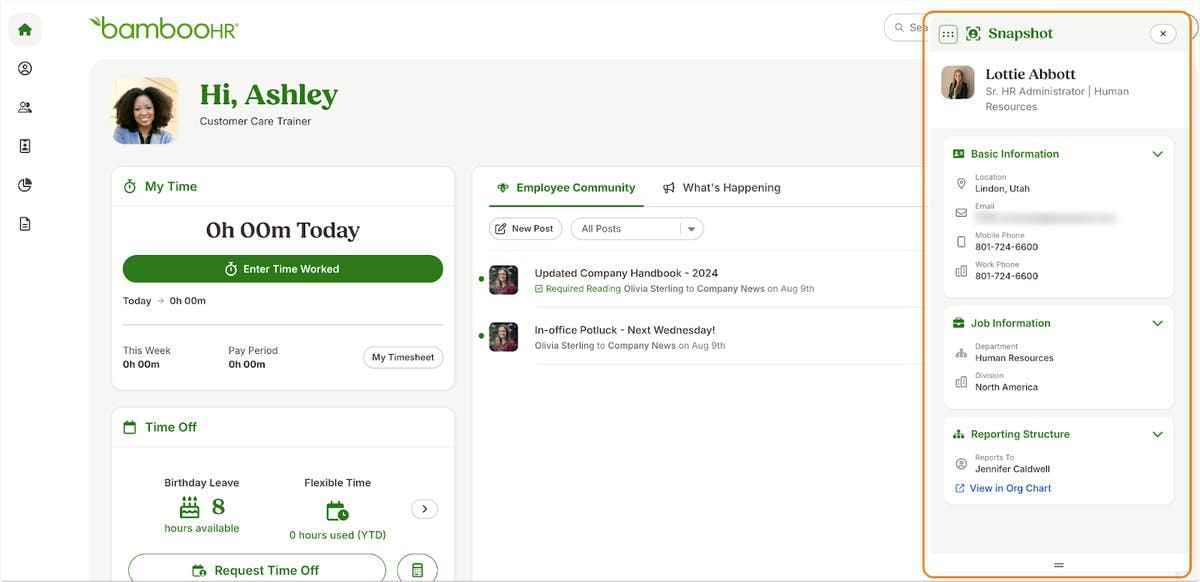
BambooHR is an HR platform that many employers and employees have used at some point to apply for a job through its ATS. That recognition builds trust in your company and could strengthen your employer branding. In this sense, it’s comparable to Workday because both are very well-known vendors.
Workday vs BambooHR is a fair comparison if you contrast their HR solutions, since BambooHR handles onboarding plus hiring and time off requests, as Workday does. But Workday is much more complex for financial planning or ERP management.
Pricing is a bit difficult to calculate. They invite you to request a quote, but they also say the Core plan costs $10 per employee per month. Why add a quote? Is it because the Core plan is a baseline you won’t qualify for? Keep in mind that integrated payroll means switching both platforms (your HR platform and your payroll workflow) the day you leave.
Gusto replaces Workday when US payroll is the job
Gusto is a software provider focused on payroll, with HR and benefits administration on the side. Its service side gives you access to health and dental carriers and gets payroll running quickly. According to users, Gusto doesn’t charge a pay-per-run fee, unlike other payroll providers.
Up to 50 people is where it works best. Many users on Reddit say that past 50 employees, the processing backlogs start to show: The solution can’t handle a bigger scale without creating new admin work. And more admin work might defeat the purpose of having a payroll solution in the first place.
Pricing is public. The Simple plan costs $49 plus $6 for the first employee (that’s why the table above reads $55), while the Plus plan starts at $80 a month and adds $12 per person per month. For 50 people that’s $680 a month, which expressed yearly means more than $8,000 spent on payroll software. Sounds a little steep said like this, but it might still be more affordable than Workday, although this is a conjecture.
Rippling replaces Workday when you need a modern suite that’s still lighter
Rippling, judging by online reviews, looks more like an ERP than an HR solution. It’s neither, actually. It’s an IT device management, software provisioning, payroll management platform, and HR platform all bundled in one complex solution. The best fit is companies with dedicated tech and HR teams that already know the tool. With Rippling, you’re going to pay a premium for it because you’re paying for a full suite that can do so much. The question is whether you really need that much.
There’s no pricing model that companies can glimpse on their own: you have to fill in a form to request a quote. A blog post they published in June this year says that pricing starts at $8 per employee per month for the core HR platform. Recruiting, time tracking, HR services, and benefits administration are separate modules. According to testimonials, Rippling gets expensive fast, but companies can do so much with it that many still choose to use it.
Personio replaces Workday when you’re based in the European Union
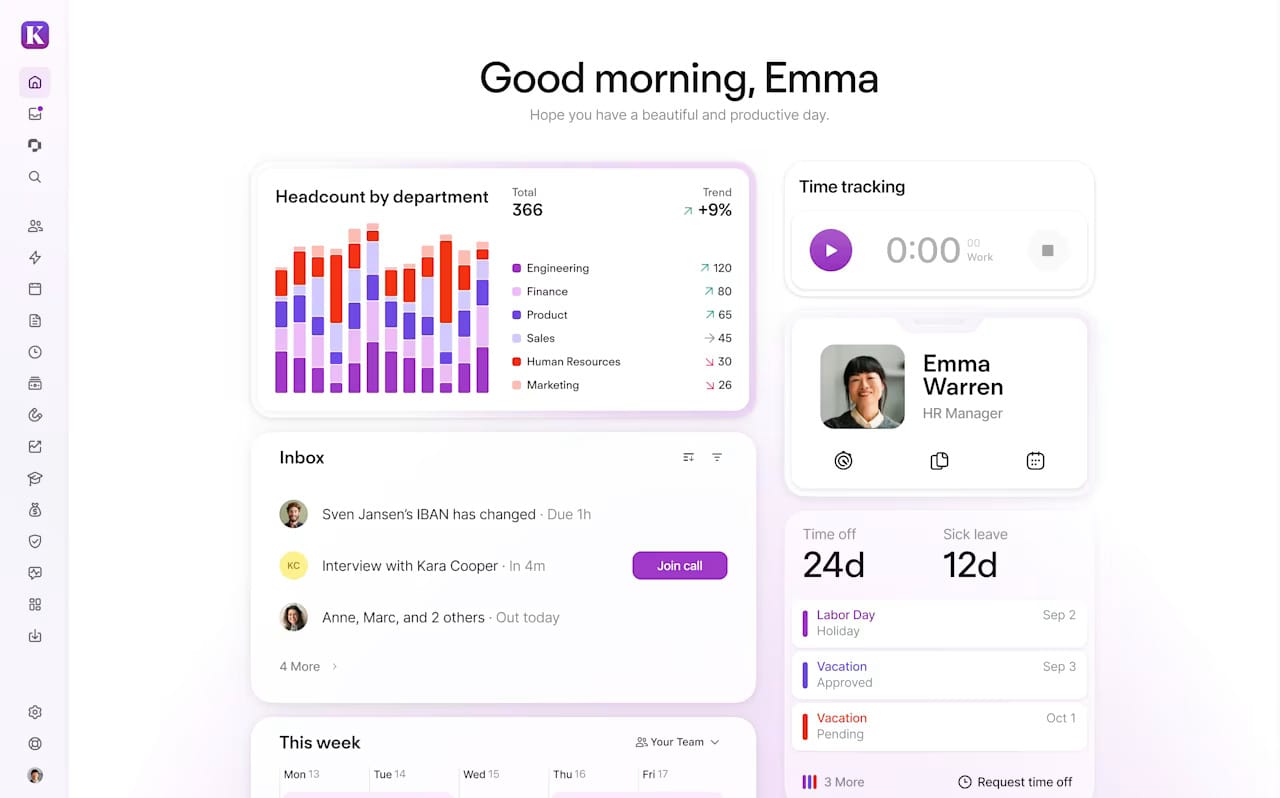
Personio is known as one of the leading European-Union-friendly HR solutions. It’s based in Munich, it’s GDPR-compliant, and it’s marketed toward EU organizations. For an SMB that wants to hire in Europe, Personio already has an applicant tracking system, like Workday, and an onboarding pipeline. It also has integrations with custom payroll processing for European countries like Germany, Austria, or the Netherlands.
In terms of time to value for an SMB, Personio is a lightweight solution that will be much less complex to implement than Workday. It’s an HR suite and not an all-encompassing software platform like Workday is. You still get the core HR features that Workday also supports. You’ll be missing out on additional features like having an ERP in the same ecosystem, but that’s not what SMBs with a European-market outlook might be looking for.
Personio’s pricing has a baseline, but no ceiling. The website states the smallest plan starts at €7.60 per employee per month. That’s where it starts, so it’s unclear how much it would cost for, let’s say, 50 employees.
When Workday is still effective
Workday solves so much (letting your employees see how many PTO days they have banked so far and handling financial aspects of a company with a single vendor is, really, quite impressive) that, understandably, it might be suitable for dozens of companies.
If you’re dealing with a global 10,000-employee company that has dealt with hiring, expense management, or the ERP in silos, Workday will be a source of relief. Thanks to it, you can finally have a single vendor, quote and invoice by month’s end, with which to address these business matters. As a company, you unify all these enterprise tools so that you can have complete management of your employees, your payroll, your admin tasks, and even allow workers to request their PTO.
If the company you’re employed by has a dedicated HR and finance team, and within that team there’s someone responsible for the HRIS aspect of Workday, then you’re actually ready to use Workday. Maybe switching to a new tool is not the right move right now. Perhaps you should look into how to own the better aspects of Workday and make the most of them.
FAQ
What are the best Workday alternatives for small business in 2026?
TalentHR, BambooHR, Gusto, Personio and Rippling. Start with TalentHR if you want nimble, straightforward HR software.
Is Workday too expensive for SMBs?
It looks like it. You cannot get a clear Workday price because Workday has so many software solutions. If you try to get the price for the HR software alone, you first need to speak with a representative.
What are the Workday competitors for mid-market?
For the mid-market, Workday competes on the HR suite against Rippling, TalentHR, or BambooHR. All offer solutions that can handle core HR tasks and integrate with other tools in a mid-sized company’s ecosystem to get more functionality.
Workday vs BambooHR?
It’s a fair comparison in terms of an HR solution, since BambooHR handles onboarding plus hiring and time-off requests as Workday does. Workday is much more complex in terms of financial planning or ERP management.
Can a small business use Workday?
Not exactly. Using Workday as a small business might end up being a bit overwhelming, and it’s hard to plan for it because the price is not publicly available.
What’s the easiest Workday alternative to set up?
TalentHR. It’s an all-around HR solution that you can set up with a few clicks, and you can migrate your existing Workday data using a CSV file.
Decision map
If you have true enterprise needs and most of the questions above came out as yes, go for Workday. Otherwise:
- If you want an affordable and intuitive HRIS, go for TalentHR.
- If you want to handle payroll in the United States, go for Gusto.
- If you want a well-known solution, go for BambooHR.
- If you’re looking for something modern, complex, but still lighter than Workday, go for Rippling.
- If you’re based in the European Union and want to keep it that way, go for Personio.
You can try TalentHR today. It’s free to get started, and you can sign up with a few clicks.