
The best Connecteam alternatives in 2026 are TalentHR, BambooHR, Factorial and Rippling on the HRIS side, and Homebase, When I Work, Deputy and 7shifts on the ops and scheduling side. They all cover different scopes, with tools like TalentHR having a stronger focus on employee records.
Connecteam’s hubs: A way to access an HRIS within Connecteam
Connecteam is a mobile-first solution for employee management aimed at deskless and mobile workers. According to a report cited by Forbes, approximately 80% of the global workforce is deskless, and Connecteam allows companies to manage this group of users, who might not even have a computer to access their HR information.
Connecteam has three modules, which they call hubs: HR and skills, communications, and operations. Companies can purchase any of the three independently, and each hub has its own plans, from basic to enterprise. HR and skills, in the basic plan, includes time off and courses. Communications includes chat, and operations has a job scheduling app and a time clock.
Up to 10 employees, Connecteam is free. Past 10 users, companies pay for each module, which starts at $35 per month for the first 30 users with the monthly pricing plan. This means the first 30 users come to about $1.16 per user per month. Then, on this plan, you pay $1 per month for each additional user. (There seems to have been a price increase recently, since we had documented that each additional user would cost $0.60. A 2025 Wayback Machine snapshot confirms this).
The advanced and expert plans come to roughly twice and three times the basic plan.
Is Connecteam an HRIS?
Connecteam is not exactly an HRIS, but it can function as one when paired with the company’s HR and Skills module. That module allows companies to run typical HR workflows like hiring and onboarding, time off tracking, or an org chart.
In a strict sense, Connecteam is not an HRIS if you’re only switching on the operations or communications modules. In all fairness, they don’t claim otherwise. When you don’t use the HR and Skills module, it looks far more like a platform to run a clock or to schedule jobs than one to keep employee records.
So, if you’re considering an HRIS platform because you thought Connecteam is limited in that aspect, you’re on the right track. HRIS platforms usually solve core HR tasks, like onboarding, performance reviews, and time off tracking. If you realize that you must have something like this, then you either buy the HR modules of Connecteam or move to a proper HRIS.
4 operations and scheduling alternatives to Connecteam
Since Connecteam is not an HRIS, it’s fair to compare it against different solution tiers. One fair comparison is against ops and scheduling solutions.
If you’re thinking of switching from Connecteam, the top solutions you can check on the ops side are Homebase, When I Work, Deputy, and 7shifts.
Homebase
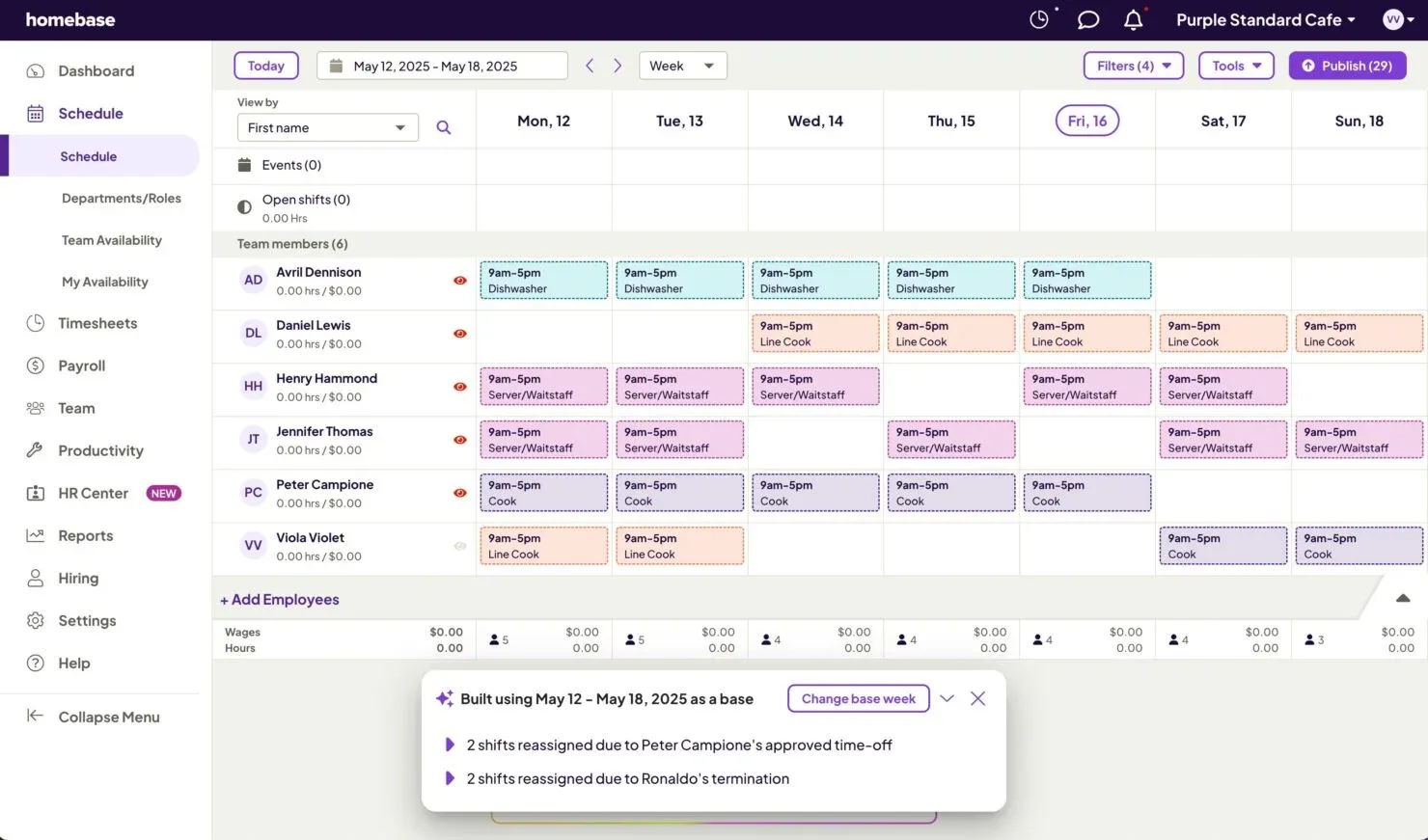
Homebase is a cloud workforce management platform for small businesses that run and manage hourly workers under shifts. It includes scheduling, time tracking and payroll as the main features, and their products page also lists hiring and onboarding, an “employee happiness” module, and a communication platform.
Their plans are built similarly to Connecteam’s in terms of the starting price. But Homebase charges per location, with unlimited employees for that location. Let’s say you have two restaurants: that would be two licenses, which on the Essentials plan come to $30 per month for unlimited employees. It includes scheduling, time tracking and communication, and you can add payroll for $39 plus $6 a month per employee paid.
If you move to Homebase, you’ll forfeit some advanced HR functions that Connecteam has with the HR hub, like document management and the ability to get e-signatures.
When I Work
When I Work is an all-in-one workforce management software focused on scheduling, and it’s designed exclusively for hourly workers. The premise of When I Work seems to be: making time tracking, scheduling, and messaging for people out in the field as easy as possible. It’s an app for deskless workers combined with a dashboard, on desktop, for those managing them.
When I Work's pricing is different from Connecteam or Homebase: they charge per location or schedule, at $2.50 per user per month with a single location. When you have multiple locations or schedules, you pay $5 per user per month. So if you have a franchise or branches, you need the multiple locations plan.
When I Work does not have an onboarding solution, so you won’t be able to hire and onboard workers with it.
Deputy
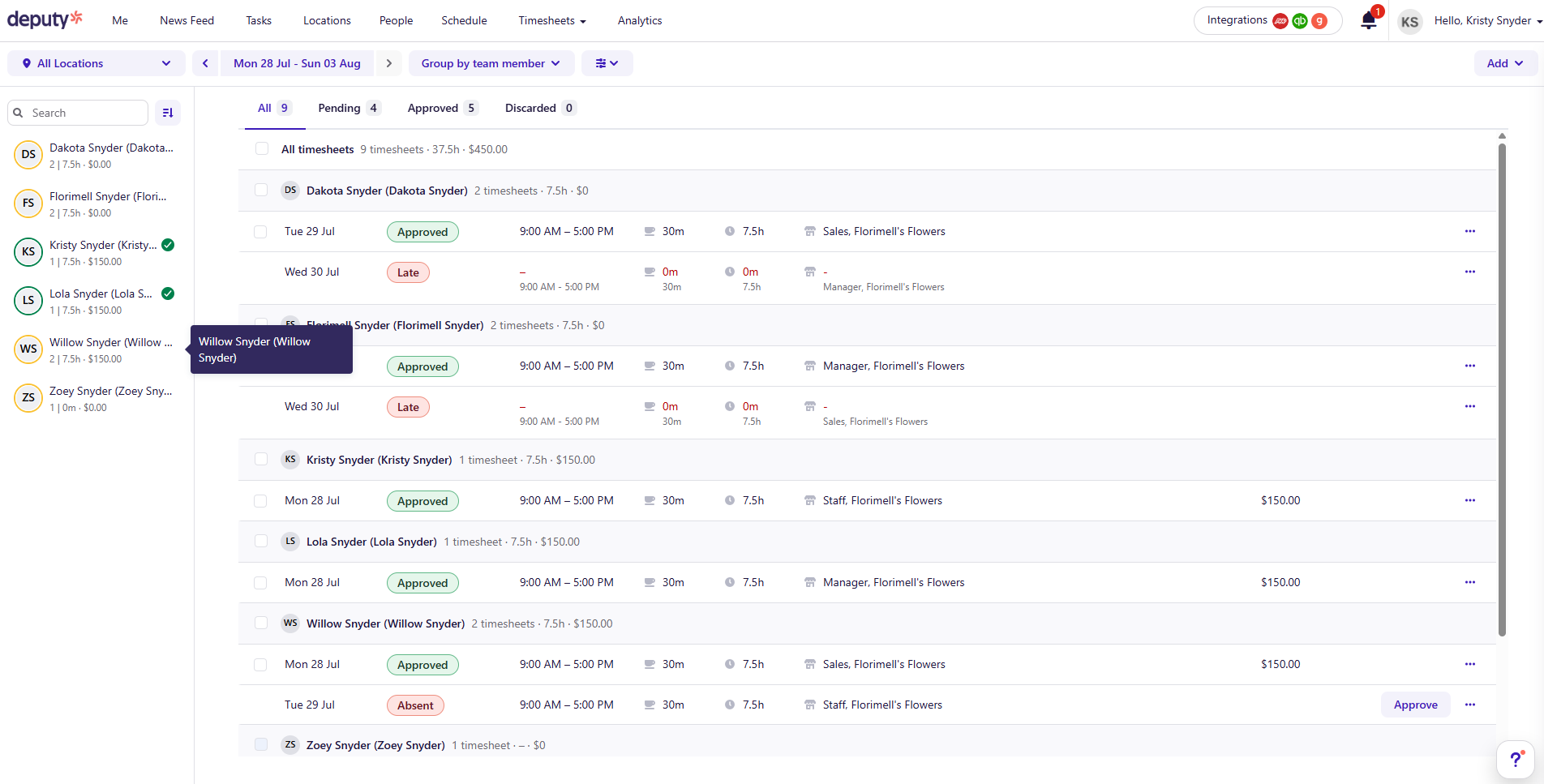
Deputy is also a solution for hourly workers that solves scheduling, compliance and timekeeping. It targets frontline workers like Connecteam or When I Work, but it has recently added an AI agent that helps those managing the shifts make the right schedules. You tell it a person is sick, and the agent proposes who can cover those shifts.
They also have an HR management add-on for hiring, onboarding, reporting, and engagement, at around $2 per month per user. The core solution, according to their website, comes to $7.25 per user per month. With payroll on top of each add-on, Deputy may be one of the most expensive solutions per user per month on this list.
7shifts
7shifts is a scheduling platform built for restaurant teams. Even though it initially comes across as an employee operations software platform, it has specs for hiring and scheduling as well as paying and training, and even retention. It’s a very comprehensive software package for restaurants, indeed.
The Essentials plan comes to around $39 per month per location for up to 30 employees, which is about $1.30 per employee per month. With this plan, companies get basic scheduling, but are left out of “advanced time clocking.” This is the only unclear item about their pricing system or their features.
All in all, 7shifts looks like a tool with great value for the money if you want to organize shifts in a restaurant. 7shifts is available in Canada and the United States, and their payroll features, which require you to schedule a call, only work in the United States right now.
4 HRIS alternatives to Connecteam
Connecteam is not an HRIS, but it can get pretty far with its HR features. If, as a company, you need to double down and get a specialized HR platform, these are the best alternatives to Connecteam.
TalentHR
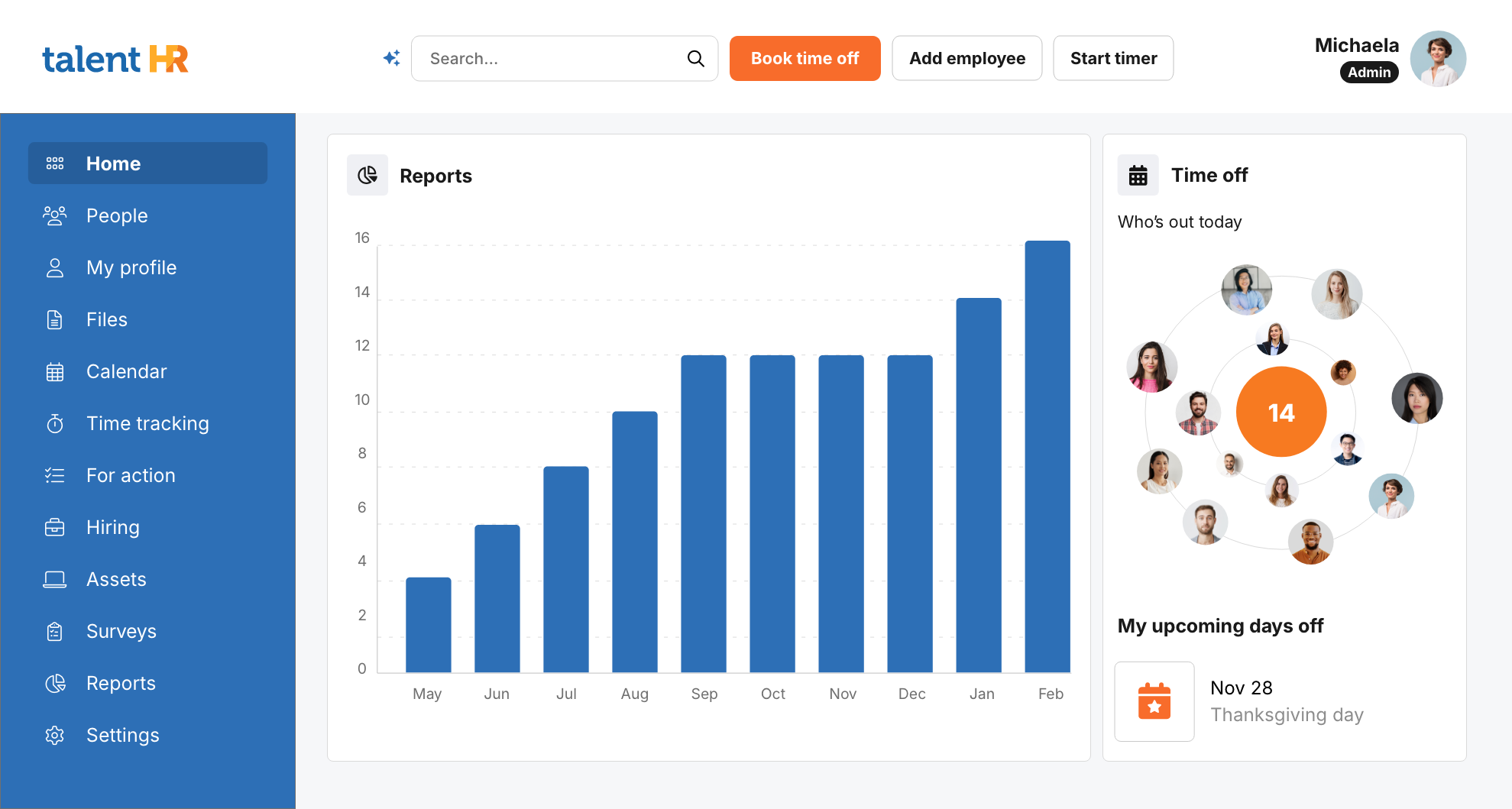
TalentHR is a nimble, affordable HR solution with transparent pricing for companies that need employee records, manage employees’ PTO and accommodate both deskless and desk workers. This is a key distinction. Connecteam favors companies that want to schedule shifts for frontline workers, but TalentHR works for desk workers as well. In terms of interfaces, they both have a mobile app and a desktop dashboard.
TalentHR is an all-around HR solution, easy to set up in two clicks, that anyone can administer. Since you can migrate your information with a CSV file, you’ll have your path cleared to move from Connecteam to TalentHR. Keep in mind TalentHR is not a payroll solution, and it’s not a shift scheduler, but thanks to its integrations ecosystem it can certainly get there.
BambooHR
BambooHR is an HR platform that has a foothold among desk workers. In that sense, it’s very different from Connecteam, and much more specialized as an HR tool. With BambooHR, companies can expect to handle onboarding, employee records, and even payroll through an additional module.
But unfortunately, pricing is difficult to understand. They invite you to request a quote, but they also say the Core plan costs $10 per employee per month. So how much it costs per month compared to Connecteam will perhaps depend on what quote you can get.
Rippling
Rippling unifies HR, payroll and IT in a single, complex platform. It’s a far cry from Connecteam’s adaptive approach to managing deskless workers, but it’s also much more complex: With Rippling, a company should be able to provision devices (phones) or software to their deskless workers from the same platform they handle payroll.
There’s no public pricing: even though their blog claims the HRIS solution starts at $8 per employee per month, users are required to fill in a form to request a quote. Still, companies moving on from Connecteam to Rippling should expect a much more expensive solution. All in all, Rippling and Connecteam are hardly comparable, since Rippling is considerably more complex and powerful, but requires a considerable time investment that Connecteam does not.
Factorial
Factorial is a European HR platform that companies use to manage payroll, time and planning, talent management, and even finance. In that way, it’s comparable to Personio, another well-known European HRIS solution, but Factorial has also added an IT management and finance layer to its product.
The Core plan comes to $8 per month per user, about four times as much as other platforms with a similar set of functions. Companies get fillable PDFs, notifications, e-signatures, onboarding, and an employee directory. In a nutshell, Factorial Core looks like a workflow organization tool that also has many HRIS capabilities. Compared to Connecteam, it’s a platform targeted at a combination of deskless and desk employees.
Regarding hiring, it’s not clear on Factorial's pricing page if you can operate the ATS. After a deep dive, if you want to use their ATS, which they do provide, you’ll have to request a custom quote or talk with sales. Or, if you were looking at HR solutions to handle hiring, maybe look into a different Connecteam alternative entirely.
Side by side: What is each product for?
This short table explains the difference between operations and HRIS solutions:
There’s a strong overlap here, since via integrations or additional modules, many tools can cover the whole life cycle of managing schedules, creating employee records, or handling payroll. Some tools are simply more specialized at covering each segment.
If what you need is to track schedules, and you have deskless workers only, perhaps you don’t need an HRIS, and you can continue engaging with a product such as 7shifts.
But if you’re looking to keep employee records, have a mixture of desk and deskless workers, and integrate payroll with multiple providers, then you should consider a specialized HRIS.
How to migrate from Connecteam
Migration depends on two contributors: the solution you’re leaving and the solution you’re moving to. If Connecteam has an export feature (spoiler: it does have one) and your new solution has an import feature, you can migrate without manual input.
So to migrate from Connecteam:
- You export your data from Connecteam
- You import the data to your new tool (so now you have the same data living in two separate tools)
- Start using a module from your new solution that you thought Connecteam was lacking, like employee records
- Gradually phase out your old solution.
When Connecteam still wins
Connecteam still wins for many hospitality or retail teams that worry about scheduling shifts and executing them. If their main concern is not employee records in many jurisdictions, onboarding or offboarding, or having a component of performance reviews or payroll, then Connecteam is more than sufficient.
But companies that need a people-centric HR solution to keep employee records can move on to a different kind of tool that covers the full employee life cycle.
- If you need the full capabilities of an HRIS, start with TalentHR.
- If you need only scheduling, pick an alternative from the Ops group, like 7shifts.
- If you need both, combine an HRIS with a light scheduler.
You can sign up and try TalentHR for free now. It takes a few clicks to set it up and get it fully prepared for your company.
FAQs
What are the best Connecteam alternatives in 2026?
The best Connecteam alternatives are TalentHR, BambooHR, Factorial and Rippling for HRIS, and Homebase, When I Work, Deputy and 7shifts for ops and scheduling. They all cover different scopes.
Is Connecteam an HRIS?
Not exactly, although it has many modules that get it close to what an HRIS can achieve, without the initial design focus on the HR aspects of talent management.
Connecteam vs TalentHR?
TalentHR is a nimble, affordable solution for companies that need employee records, manage PTO and combine deskless and desk workers. Connecteam favors companies that want to schedule shifts for frontline workers.
What’s the best alternative for restaurants or hourly teams?
7shifts is an excellent Connecteam alternative for restaurants, although it looks too localized for Canada and the United States, so it depends on the region you’re serving.
Can Connecteam replace BambooHR?
If what you lack is a handy way to organize shifts, then yes. If you’re looking for HR software for employee records, then no, you’d be better off looking for something else.
How do I switch without losing schedules?
Have both solutions working at the same time, export from Connecteam, import into your new solution, and gradually phase out Connecteam.