
Pricing information is checked on vendor sites in September 2026.
The best Gusto alternatives for nonprofits and NGOs in 2026 are TalentHR, OnPay, Rippling, BambooHR, Deel, and ADP RUN. TalentHR is the affordable, nimble HR platform that a lean nonprofit can set up and run without an admin team, and it also integrates with payroll providers via Zapier and Make.com (for example, the one your board or a major donor recommends). Full disclosure: TalentHR is our product, which is why it's listed first. We've tried to be fair to the other five.
Each tool mentioned above addresses a Gusto constraint that nonprofits may be currently dealing with. Other nonprofit payroll software worth a look includes Paylocity, whose nonprofit guide covers Form 990 prep and grant-funded salaries, and Checkwriters.
The constraints nonprofits usually have to deal with
Nonprofits usually have to make decisions while facing three stressful conditions. These can be summarized as:
- Having a tight budget while being held accountable by donor organizations,
- Using the limited bandwidth of a small, lean admin team properly, and
- Being afraid of falling outside their compliance status.
Let’s discuss it.
A tight budget with limited bandwidth for mandatory admin work
Besides having a tight budget for admin tasks, nonprofits have a very limited bandwidth or capacity. Most admin teams are lean and “skeleton crews.” But someone still has to make sure staff can take their days off, that payroll is met, and that those days get tracked!
Board scrutiny and the 501(c)(3) concern
Every nonprofit finds itself in a challenging situation: even without a for-profit incentive, it still has to follow compliance rules as strict as any company's. For example, if they receive a grant, they need a clear breakdown of what it was spent on, and their mix of contractors, salaried staff, and volunteers has to be classified as different parts of the workforce.
Many nonprofits reckon that donors scrutinize administrative costs with special focus, and that they need to be able to report their spend. Being able to transparently report their administrative work has broader implications: a top concern for a nonprofit is its tax-exempt status. Payroll tax errors mostly cost penalties and interest, but the IRS automatically revokes a 501(c)(3) that doesn't file its annual Form 990 for three years in a row, and messy payroll records make that return harder to file.
One of the ways nonprofits deal with these circumstances is by using software solutions to navigate this environment. Gusto is one such software solutions.
What Gusto is great at for nonprofits
Gusto is a payroll-focused provider with a human resources branch. Nonprofits that subscribe to it do so to address many of the circumstances we mentioned above. Some of its stronger qualities are:
It has a self-service tax setup
If a nonprofit's biggest difficulty is an administration so lean that one person holds the entire roster of employees, volunteers, and part-timers, then Gusto letting your team members enter their own W-4 matters. They can do it during onboarding and after it, the system updates itself, and you stay current with the IRS. You can have staff in California and part-timers in Pennsylvania and Gusto handles that split (multi-state payroll starts on the Plus plan), and it automates exceptions: you check one box to apply an exemption, such as the FUTA exemption 501(c)(3) organizations get.
Benefits carriers and payroll that runs fast
At year-end, Gusto creates and distributes W-2s for the core staff and 1099s for the contractors automatically, and it handles multi-state filing for tax compliance. It integrates with accounting solutions, and because it has struck partnership agreements with service providers, it also connects you with access to benefits carriers for health or dental.
Gusto constraints that nonprofits and NGOs might experience
But Gusto has some limitations that will catch the attention of some nonprofits. The top constraints all have a way out in the form of a different software solution:
Gusto alternatives for nonprofits in 2026
If you’ve read the table and realize you’re facing one of those constraints, we invite you to read the solution that addresses them.
TalentHR
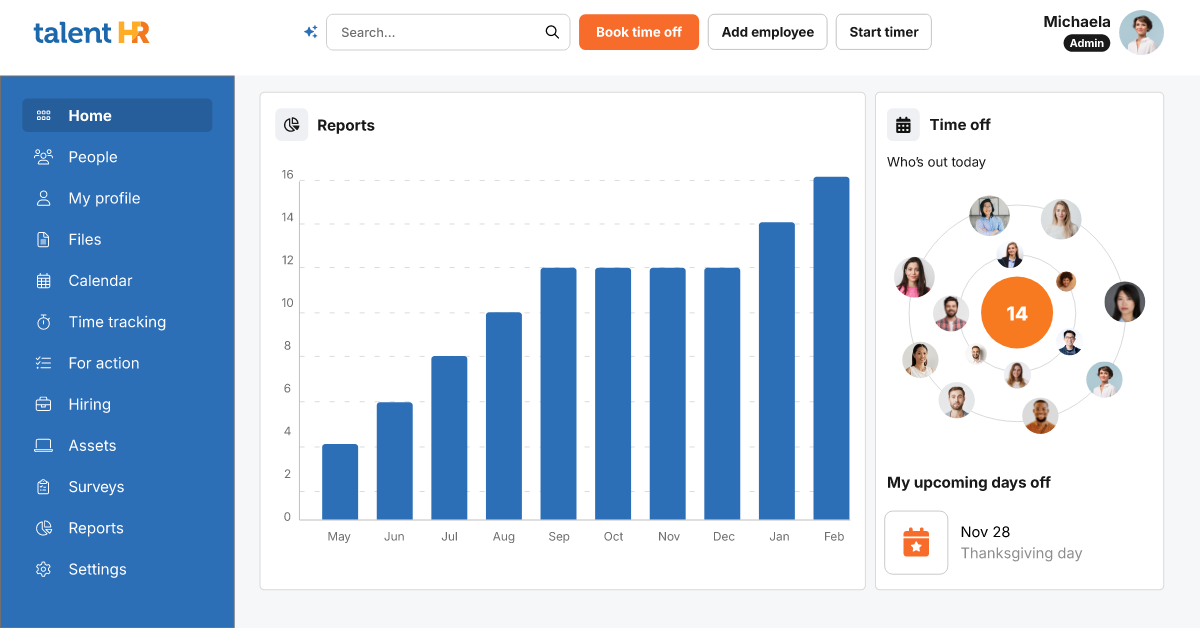
If you realized that Gusto stopped scaling beyond 50 employees, and the cost was too high to begin with, then you should consider TalentHR.
On Gusto, some users point to a ceiling: for up to 50 workers, it performs correctly, but past 50, the system can’t handle the processes without demanding extra work. Even processing backlogs will begin to pile up.
On Gusto, there is no advertised nonprofit discount either. On the Plus plan, you start at $80 per month and add $12 per person per month, so run the math at 50 employees, and it’s about $8,200 a year. And the testimonials do not say performance or the value-for-money ratio gets better as you grow. A nonprofit then has to explain why it spends $8,200 on software that covers an administrative item instead of the mission.
TalentHR arrives packaged as nonprofit HR software that is lightweight, easy to set up, and manageable by anyone. It connects to payroll providers through Zapier and Make.com, so nonprofits can keep paying staff in multiple jurisdictions, in the US and elsewhere, through a provider they choose. Its integrations page lists everything else it connects to, and the pricing is per user, from $2 per user per month billed annually, with a very generous free plan available as well. NGOs also get a 20% discount.
TalentHR works for a team of 20 or a team of a few hundred, because it’s been designed for organizations that might be small presently but plan to grow later on.
The risk of vendor lock-in with TalentHR is low. Employee information, time off, assets, and more can be exported to CSV and imported from CSV, and you can drop your payroll provider while keeping TalentHR, because payroll connects through Zapier or Make.com rather than being built in. Still, this is not a payroll solution. It is the platform that helps you onboard, record how each worker is classified, and keep your records audit-ready, with reporting off dashboards and AI tools that nobody needs an HR background to read.
Rippling
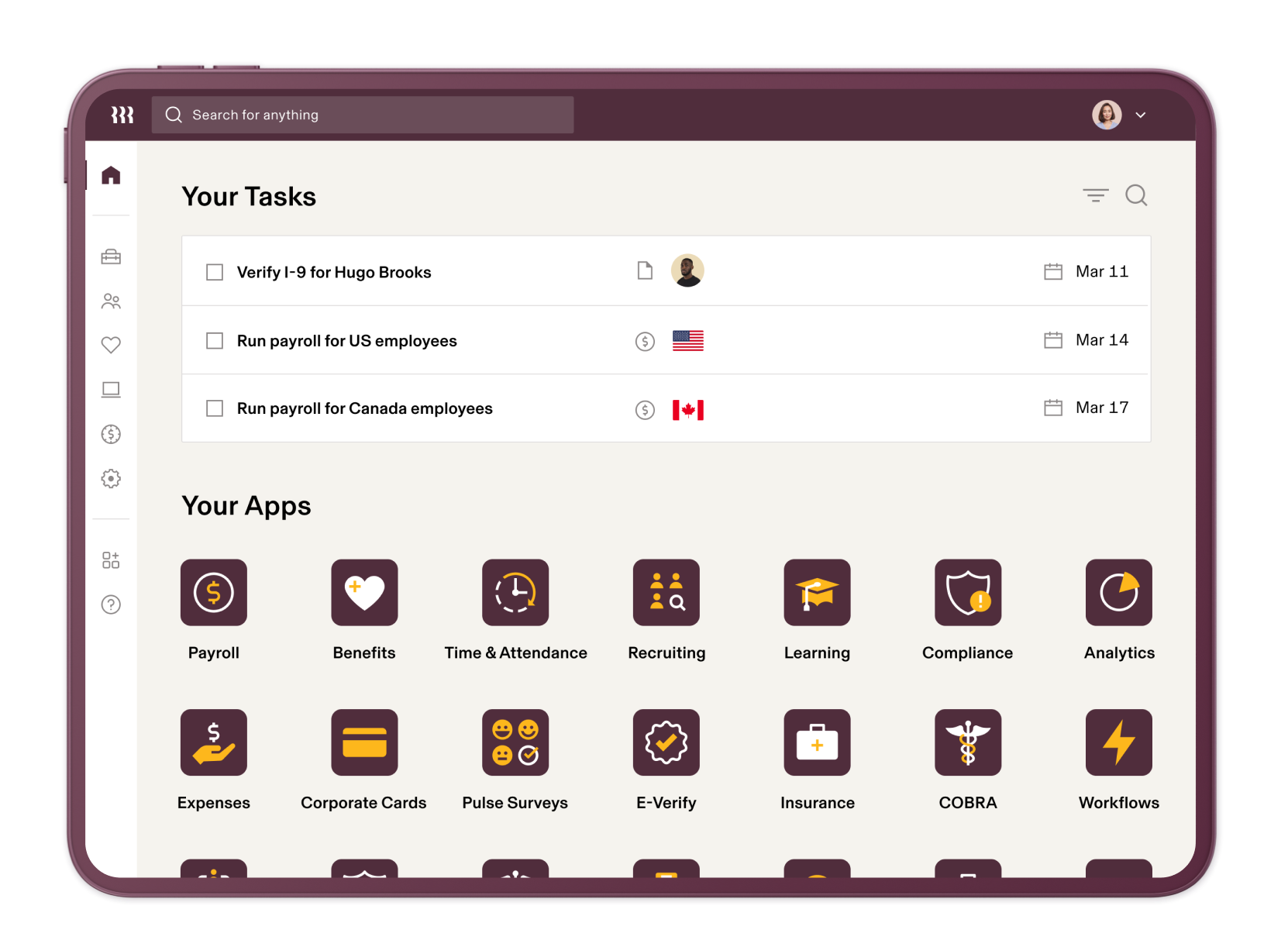
If you need to divide and track your funds into separate digital buckets to prove to donors how you’ve been using their restricted grants, then you might consider Rippling.
With Gusto, in part due to its straightforward layout, it is difficult to split payroll costs by grant: its QuickBooks Online sync maps only one class per journal entry. If you have grants with restrictions, keeping the money separate for each grant takes manual work. With several funding sources, you might need to log a given group of employees so their hours land under different sources.
Rippling lets you tag payroll costs by grant before you sync to your accounting software. You can map employee costs granularly, apply class codes, work the gross-to-net splits, and manage complex allocation rules. That is how a nonprofit understands which projects ran and where the grant money came from.
Rippling comes with payroll, HRIS, and IT management in an all-in-one platform, which can make it too complex. There is no NGO or nonprofit pricing, and they expect you to request a quote, with time tracking, HR services, recruiting, and benefits administration as separate modules. Buried in their site, they advertise their pricing of $8 per employee per month for the core HR platform, with a $40 monthly base fee on top. It’s hard to understand how much Rippling will cost a nonprofit.
OnPay
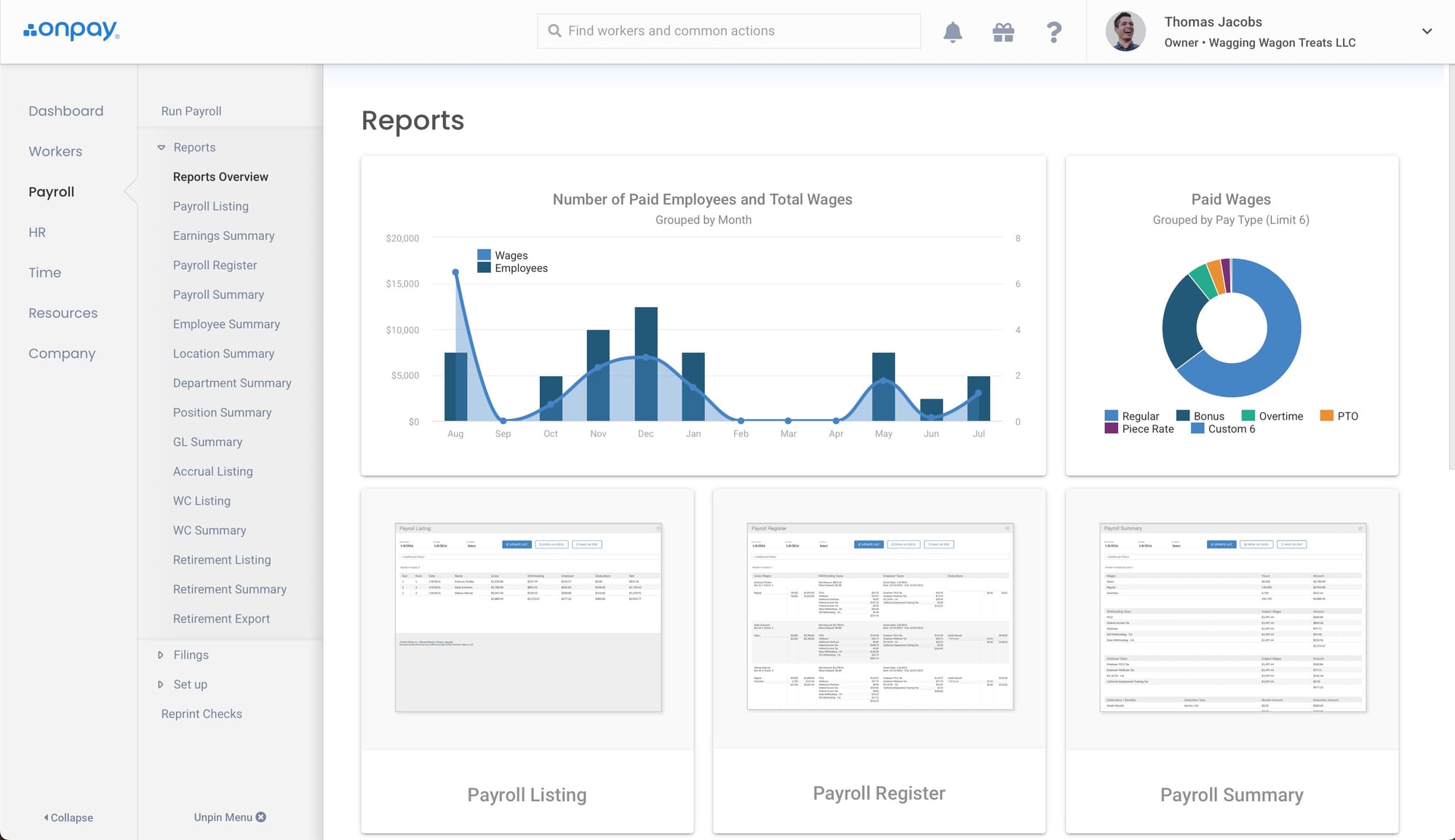
If you use Gusto, you might be carrying out workers’ comp audits by hand. Unless you use Gusto’s integrated pay-as-you-go workers' compensation insurance feature, when somebody asks you for a manual audit you are calculating the risk codes on your own.
OnPay bundles pay-as-you-go workers' compensation, so each payroll run calculates and pays the premium against real-time wages and classification codes and no large lump sum lands up front. It integrates with insurance carriers to automate the policy updates when you add members, and it exports audit-ready reports. OnPay costs $49 per month plus $6 per employee to start, and its HR add-on is another $15 a month plus $2 per employee.
OnPay is a payroll and tax automation platform instead of an HRIS. It onboards people and administers benefits, but it lacks HR features an NGO needs, such as an ATS or international payroll. Pay attention to the cost center and class tracking since they’re not their primary selling points.
If you’re already on Gusto and you didn’t like their insurance feature, OnPay is worth a look.
ADP RUN
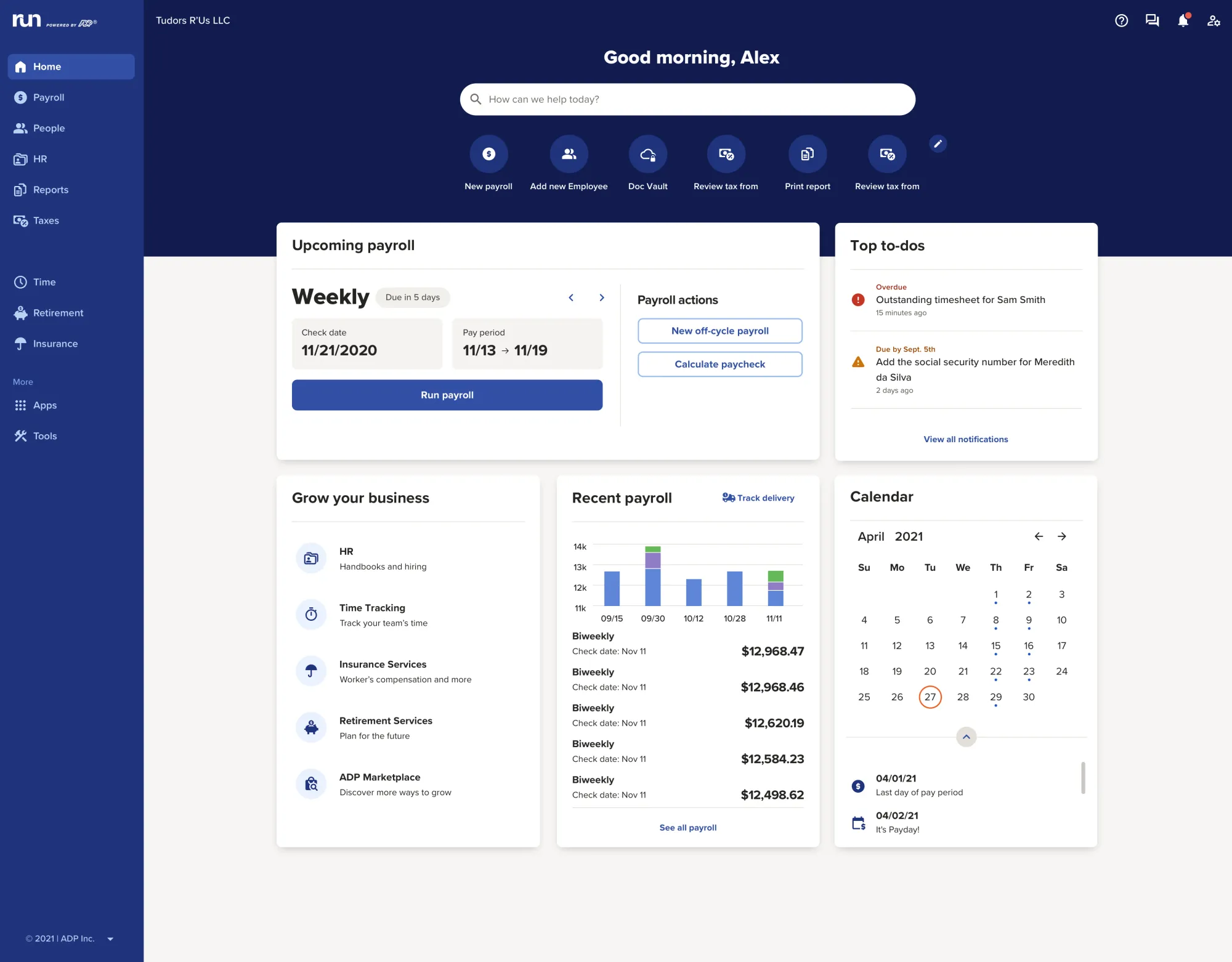
Nonprofits celebrate how simple Gusto is, but users agree that, when they need to address an issue, support is lacking. From what users share online, reaching them is hard if you contact them around a holiday. And in the payroll department, making a mistake during a holiday is not exactly an edge case! Perhaps the software grew faster than the support organization behind it.
What you can do instead is move to ADP RUN, and the argument is that it is a company with more years of history to show for it. That buys you, perhaps, peace of mind for a board of directors (“nobody gets fired for buying IBM,” as the old chestnut says), or for the decision-makers awarding your grants, because they know the brand and have used it inside companies for years.
It is still a payroll tool with HRIS add-ons and an unclear pricing model, so you will be asking for a quote. The testimonials all talk specifically about a pay-per-run cost. This means every run carries a charge, and year-end W-2 and 1099 work come as a surcharge. Also, users tend to say ADP RUN’s general ledger is more rigid than Gusto’s, and this can imply a steeper learning curve.
Please note that ADP RUN is not ADP's PEO service, which is ADP TotalSource. It's a cloud-based solution.
BambooHR
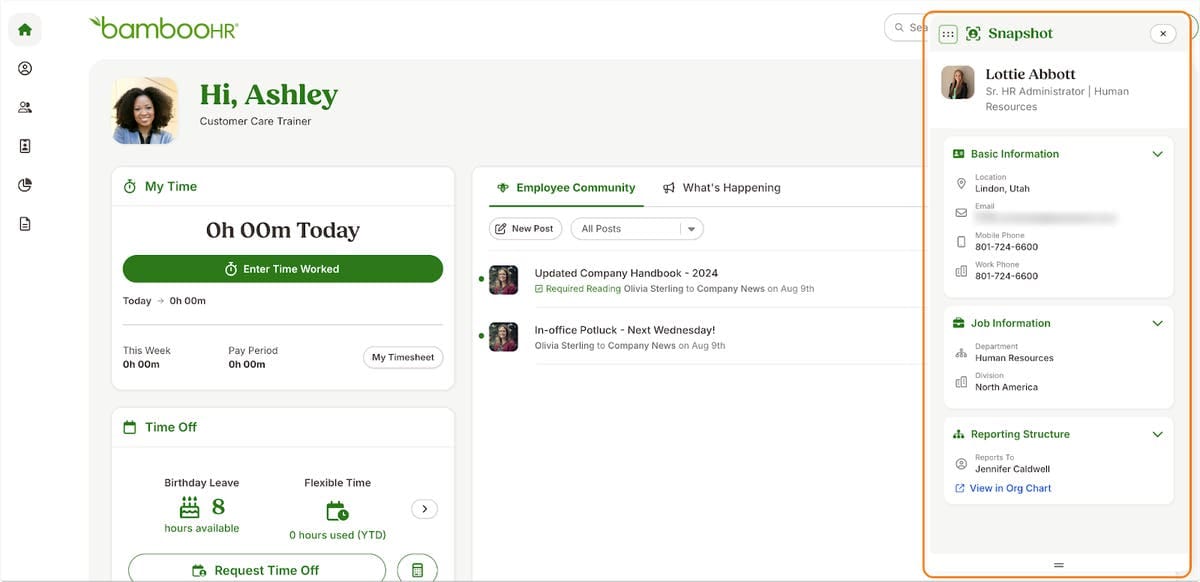
New Gusto accounts on the Simple plan don't get custom admin roles, and Plus includes only one, so it's hard to give an external auditor safe access without exposing information that only an executive director should be seeing.
They can switch to BambooHR instead. BambooHR is a well-known human resources platform. On it, nonprofits can make an auditor profile and hand it over to the right user. It also sells its own payroll service, BambooHR Payroll, as a paid add-on, so it can cover both sides at once.
Unfortunately, nonprofits that are planning a move from Gusto will realize that BambooHR’s pricing system is peculiar. On their website, they invite you to request a quote and also state clearly that the Core plan costs $10 per employee per month for teams of 26 or more. Smaller teams pay a flat rate that starts at $250 a month. It does offer registered nonprofits an extra 15% off, which you arrange through their sales team. Still, somebody has to build and maintain those roles, so the granularity arrives as an extra layer of administration. BambooHR also has payroll bolted into its HRIS. This can be either a blessing (you can solve HR and payroll with a single stroke!) or a curse (you’re locked in with a vendor that does two things rather than one).
Deel
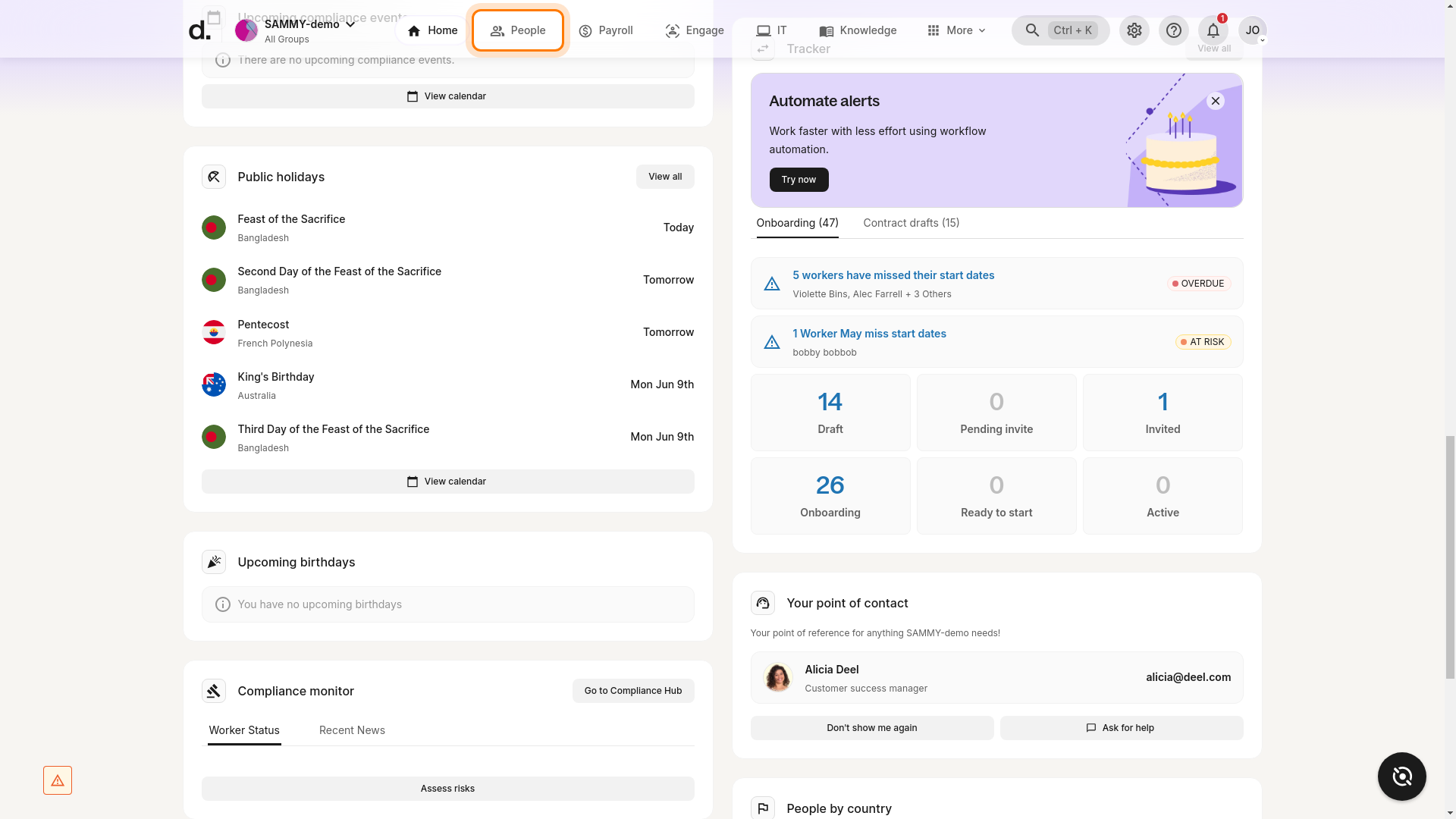
Nonprofits will realize that, with Gusto by itself, they can pay contractors in 120+ countries, but they can only hire employees abroad in a handful of countries (through Gusto's partnership with Remote).
Deel is almost the reverse case here. It’s a platform built to handle contracts abroad, and it onboards your international contractors and, through its employer of record service, staff hired abroad, so you skip setting up legal entities in other countries. Contractor pricing starts at $49 per contractor per month, with extra costs on top.
Deel’s capabilities are sometimes confusing, because it bundles software, payroll solutions, and services under a single brand. So a lean NGO has to work out whether what it needs is an employer of record (a service for hiring abroad that is separate from the software). Nonprofits should look out for the cost, and whether they get the granularity to account for where each staff member’s salary comes from.
Switching payroll: Overlap two solutions
Switching payroll is easier to write about than to actually perform since it means, at first, using two solutions at once. These are the steps to switch payroll in a nonprofit.
Overlap and phase out
If you have two groups of staff, or one group whose funding comes out of two different grants, start by mirroring one group in your new solution.
Yes, you’re going to have two solutions overlapping: Gusto keeps paying everyone while you run that group’s payroll in the new system, without sending any money, and compare the numbers. You’ll be running two solutions in parallel. Sounds awkward, but it’s the best way to make sure you’re ready.
Once you have validated that your new solution does what you need it to do, you can phase Gusto out and make sure that every group is getting paid on this new solution. Time that final move for the start of a quarter (January is cleanest), so one provider files each quarterly Form 941 and nobody has to stitch quarter-to-date wages together from two systems.
Understand the new reporting before leaving
You also need to understand how the reports and the audits flow out of the new system, and to make sure everyone is acquainted with them. That means coordination between whoever owns the budget or the cash flow and whoever holds the accounting. In a nonprofit, that can definitely be the same person (wearing many different hats).
Only phase Gusto out once you understand how the new reporting systems work.
When Gusto still fits nonprofits
If your real pain is payroll, meeting tax compliance, being audit-ready, and covering benefits on a flexible platform, and you are currently staffing under 50 workers and based in the United States, then yes, Gusto will work for you.
If you are an NGO with a lean budget, TalentHR. If you need a US payroll specialist, OnPay, or stay on Gusto. If you are a global NGO, you can go with Deel. If you need an IT and HR suite and you have a generous budget, Rippling. If an external auditor needs locked-down access, BambooHR. And if you want an established player, go for ADP RUN.
You can try TalentHR free today. Test it and see how it works with your current payroll provider.
FAQs
What are the best Gusto alternatives for nonprofits in 2026?
The six best Gusto alternatives for nonprofits in 2026 are TalentHR, OnPay, Rippling, BambooHR, Deel, and ADP RUN. TalentHR is the affordable, nimble HR platform that a lean nonprofit can set up and run without an admin team, and it connects to other payroll providers through Zapier and Make.com. The other five handle payroll, global hiring, or both.
Is Gusto good for NGOs?
Yes, for US-based NGOs. Gusto works well for NGOs, and users online praise it. It unravels, though, as the NGO grows past about 50 people, and it can only hire employees abroad in a handful of countries.
Gusto vs BambooHR for nonprofits?
They are not the same thing, because Gusto is a payroll and tax compliance solution and BambooHR is a human resources platform with a payroll add-on. So it depends on what you have to do. If you want to onboard a lot of people and you have no problem carrying an additional layer of administration, BambooHR will suit you. If payroll, taxes, and benefits are most of the job, Gusto is the better fit.
What are the international NGO options?
Deel is the main option, since it's built for international contractors and, through its employer of record service, staff hired abroad. Gusto pays contractors in 120+ countries but hires employees in only a handful. TalentHR can cover your people from anywhere, and it connects to different payroll providers.
What is the most affordable Gusto alternative?
On affordability and on how transparent the pricing is, the best alternative is TalentHR, with a free plan, paid plans from $2 per user per month, and a 20% discount for NGOs. It is a human resources platform you can then connect to whichever payroll provider you prefer, or whichever one the board or your grantmakers prefer.
How do we switch from Gusto without breaking payroll?
Overlap the switch and gradually move towards it. If you have two groups of staff, or one group whose funding comes out of two different grants, mirror one group in the new system while Gusto keeps paying everyone, compare the numbers, then move everyone over at the start of a quarter. A good way to test several providers is to run a platform like TalentHR that connects to them, instead of a spreadsheet.