
Originally published on Aug 01, 2024. Updated on Jul 04, 2026.
The best absence management software in 2026 is TalentHR. For teams operating in multiple countries, Calamari and Absence.io are good alternatives. Timetastic is helpful for small businesses in the UK, and BambooHR or HiBob are reliable for companies that want a full HRIS. Absence management means handling an employee's time away from the office, whether that is annual leave, sick time, vacation, or statutory leave. Managing absences boils down to three core actions: letting people take that time, keeping records current, and maintaining an audit trail that anyone can verify. That way, the time off does not conflict with what the company owes or needs from an employee.
This piece is for HR operations leads, people managers, and founders at small and mid-market companies of 20 to 500 employees. The fit is a team that wants a dedicated leave or absence tool, or an HRIS with time-off tracking it can rely on through 2026.
The scale is real. The US Bureau of Labor Statistics put the full-time absence rate at 3.2% in 2025. On any normal week, a share of the team is out, and someone has to track it.
Our Picks at a Glance
The table below maps each pick to its buyer, with the starting price verified in July 2026.
How We Evaluated These Tools
We tried to get multiple viewpoints from the tools we picked. At TalentHR, the team sits on the product side and works with the software every day. For the other vendors, the evaluation draws on user testimonials from Capterra, Reddit threads, and forum write-ups worth an opinion, as well as each company's official pricing and feature pages.
Five criteria shaped the picks:
- Jurisdiction coverage. A tool that handles employees in more than one part of the map and avoids being locked to a single region.
- Flexibility of the accrual methods. Different accrual methods for different classes of employees, such as part-time and full-time.
- Integration depth. How well the tool plugs into a flow a company already runs, such as payroll or a shared calendar.
- Mobile-first UX. Ease of use, and enough mobile support for non-desk employees to file requests from a phone.
- Pricing transparency. A price on the website. When a company asks for a quote or a sales call before a 200-person team can even think about using the product, that counts against it. That scope of sale belongs to the enterprise level rather than to the HR lead at a mid-sized company.
Those same criteria rule tools out. Software built only for enterprises, or buried inside an ERP, falls outside the scope of this roundup, so it does not appear here to fill a slot.
All-in-One HRIS With Strong Time Off
This group brings the five core HR features under one roof, with time-off tracking as part of the package.
TalentHR
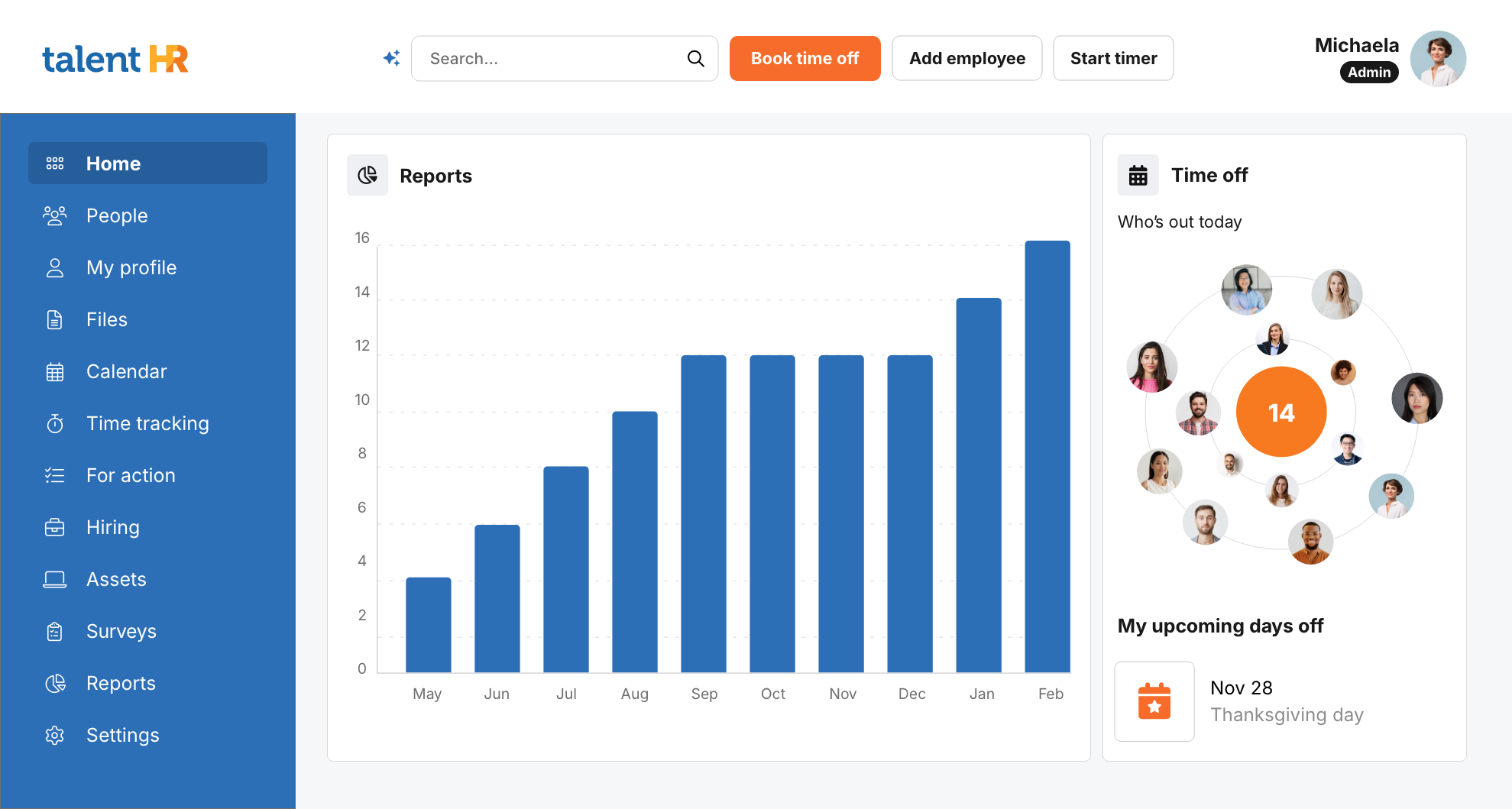
TalentHR leads this list as an all-in-one solution whose core functions give a company its first footing in HR software, and one of those functions is time-off tracking. Time-off tracking is one way to manage absences. The platform lets a company choose the accrual method and assign a different accrual policy to each employee class, such as part-time or full-time.
The same software then lets employees request their own vacation days on their own initiative. That is a quick win: with little effort from the company, employees gain agency over their absence days. Because it is a single platform, it also handles onboarding, so every record starts living under a single employee profile. The days taken and the days left remain visible to both the employee and the company, and they carry through to offboarding for a final payout.
In 2025, TalentHR added an AI HR Assistant that answers platform questions and helps configure the product, with even more AI workflow automation features rolled out recently. Each HR team finds its own best use, since the idea behind TalentHR is to fit each case. Pricing starts at $2 per user per month, with a free plan for up to 10 users also available.
BambooHR
BambooHR is a well-known solution, recognized above all for its applicant tracking system, which many employers and employees use to interact. The drawback when using it as an absence management tool, and it matters to this evaluation, sits in pricing transparency.
BambooHR runs a pricing page, but before any number appears, it hands over a form to request prices, so the figure is never clear up front. Their own breakdowns (even if they still prompt the user to request a quote) put the entry point around $10 per employee per month, well above other HR tools, in some cases up to five times the price of a first plan. To start using its time-off and PTO request features, which are two sides of the same coin, the vendor offers a demo. That says nothing bad about the product, but it does suggest some early friction for teams that simply want to get absence management up and running without extra steps.
HiBob
HiBob is an established HRIS that builds time and attendance into its Core HR suite and connects it to payroll and shared calendars. That makes it a sound way to solve the problem. Time off sits in Core HR, while broader attendance tracking comes as an add-on.
The site does not state the cost up front. The first thing it offers is a demo, and close behind it, a payroll integration. So it stays unclear whether the product works out of the box with a PTO-to-payroll link or whether that link is a module to buy. Either way, a buyer books a demo before starting, which adds friction at the front door.
HiBob earned a respected reputation centered on Britain and the UK, with the complexity and marketing focus it carries. Reviewing the product, the team has put serious effort into adapting to the US market, and so far it has worked, with a US payroll that looks like quite versatile. Crossing that border counts in HiBob's favor.
Dedicated Leave and Time-Off Tools
A dedicated tool does one job and does it close to the ground, which suits a company that wants leave tracking without a full HRIS.
Timetastic
Timetastic is a dedicated absence tool that many small companies around the world use. The vendor started it for the European and British markets. Any company can run it, with two things worth knowing. It runs on Microsoft's Azure cloud in the UK and leans heavily on GDPR, so it does not natively cover US employment rules that keep shifting through 2026.
Timetastic prices in pounds sterling, at £1.20 per user per month, which poses no problem, since the currency converts to dollars at billing. The vendor is also a certified B Corp and offers a 50% discount to other B Corps, charities, and NHS trusts. Some online comments note friction around compliance for multi-country teams, for example, holding Britain and the United States to their respective rules at the same time.
Global and Multi-Country Accruals
For a workforce spread across borders, a tool built to track accruals by country saves the kind of reconciliation a spreadsheet cannot handle.
Calamari
Calamari is built for global teams. Its leave management module runs across 106 countries with public-holiday calendars for more than 110 regions, automatic entitlement calculations, and multi-stage approval workflows with delegation. Employees can file requests through the web, mobile, or Slack and name a substitute.
The Time Off module starts at $2.50 per user per month, with a 14-day free trial and no credit card required. Pricing is modular, so a company picks the modules it needs, with a 10-seat minimum.
Absence.io
Absence.io serves the EU mid-market, with a clear German focus. The company builds everything in its own offices in Munich and Berlin. It stores data on ISO-certified servers in Germany, so it stands as a GDPR-compliant choice for a European buyer. The web interface runs in German, English, and Spanish.
Pricing on the vendor's page starts at €2.99 per user per month for the Starter plan, with a popular Pro plan at €4.99 and a Complete plan at €7.99. Annual billing takes 10% off, and a 14-day free trial needs no credit card.
Adjacent Tools We Excluded
Some tools that show up in absence roundups sit in a different market. This section names them with the reason instead of ranking them against the picks above.
Kissflow. Kissflow is a low-code workflow platform for building enterprise apps, so no, it's not a proper dedicated leave tool. Its entry point lands around $1,500 per month according to third-party listings, and its own page is now quote-based. That price puts it outside the same market as the rest of this list, which is the reason it moves here.
What Changed for Absence Management in 2025 and 2026
Several rules took effect across 2025 and 2026 that touch how companies track and report leave, and a buyer evaluating software through 2026 has reason to keep them in view.
In the UK, the Neonatal Care Leave and Pay entitlement came into force on 6 April 2025. It gives eligible parents up to 12 weeks of leave as a day-one right when a baby spends seven or more continuous days in neonatal care.
In the EU, the Pay Transparency Directive carries a transposition deadline of 7 June 2026. Employers with 100 or more staff report gender pay-gap figures, which pushes companies toward gender-disaggregated workforce and absence data. Several EU states, among them France, Belgium, Portugal, and Spain, also enforce a right to disconnect, so accurate working-time records and clear after-hours policies carry more weight.
In the United States, new state paid-leave programs reach employees in 2026. Minnesota Paid Leave and Delaware's program both begin paying benefits on 1 January 2026, each offering up to 12 weeks. The federal FMLA still sets the floor: 12 weeks of unpaid, job-protected leave at employers with 50 or more staff.
Features to Look for in Absence Management Software
The right tool offers a short set of features that turn a manual chore into a self-running process.
Automated Leave Tracking and Approval
The core of it: an employee files days on their own and stays autonomous, and approval lands in a couple of clicks. The process should not mean knocking on doors, a back-and-forth of Slack messages, forwarded emails, or an awkward chat at the watercooler in which an employee hints that they'll be absent next Monday.
Customizable Leave Types and Accrual Rules
A tool needs custom leave types, policies, and accrual rules. This matters for companies with several classes of employees, such as part-time staff, full-time staff, and contractors, each with its own accrual policy.
Real-Time Reporting and Analytics
Live reporting shows balances, requests, and patterns as they happen. Absence data often names a reason, which makes it personal data, so reporting needs to respect GDPR and the data-protection assessment that absence-reason data calls for.
Mobile Access
Non-desk employees file and check leave from a phone, so mobile access decides whether much of the workforce can use the tool at all.
Payroll Integration
A link to payroll carries approved leave and accruals straight into the pay run, which removes a monthly round of manual reconciliation.
Compliance With Local Statutory Leave
Statutory rules differ by region: UK statutory sick pay, US FMLA at employers with 50 or more staff, and the EU directive minimums. A tool that handles the right jurisdictions keeps a multi-country team on the right side of each one.
Pricing Transparency and a Free Tier
A price on the website and a free tier or trial let a buyer test the tool before a sales call. A vendor that gates the first look behind a quote adds friction that a small team rarely needs.
Choosing Absence Management Software That Fits
The right pick comes down to scope. A company with people in one country and a simple policy fits a dedicated tool such as Timetastic or Calamari. A company that wants leave alongside onboarding, records, and reporting fits an all-in-one HRIS, and TalentHR leads that group on price, transparency, and time-off tracking under a single employee profile.
The thread across every pick is friction. A tool that shows its price, opens a free trial, and lets an employee request days without a chain of approvals will see adoption that a quote-gated platform rarely matches.
You can start free and try TalentHR today. It takes a single click.
Absence Management Software FAQs
What is absence management software?
Absence management software tracks, records, and approves employee time away from work: annual leave, sick days, vacation, and statutory leave. It holds the records in one place, runs an approval workflow, and keeps an audit trail that the company and the employee can both check.
What's the difference between PTO and absence tracking?
PTO tracking follows paid time off that an employee earns and spends, such as vacation days. Absence tracking covers the wider picture: paid and unpaid, planned and unplanned, from sick days to statutory leave. Most tools handle both under one system.
Is absence software a legal requirement?
No law forces a company to buy absence software. The law does require accurate records and statutory leave, such as the US FMLA, UK statutory sick pay, and the EU directive minimums. Software makes those obligations easier to meet, but a compliant spreadsheet can satisfy the rule at a small enough scale.
What's the cheapest absence management tool?
Among the verified picks, Timetastic is the lowest at £1.20 per user per month, and Calamari starts at $2.50 per user per month. TalentHR offers a free plan for up to 10 users, making it the lowest-cost option for a small team that wants a full HRIS rather than a single-purpose tool.
 Set your PTO policy once. The rest is automatic.