
Originally published on Oct 09, 2024. Fully updated on Jul 03, 2026.
There are free HR software for small businesses in 2026. The strongest genuinely free picks are TalentHR (free for up to 10 users) and open-source tools you can self-host and pay only for the infrastructure, like Frappe HR. Zoho People is free for up to 5 users, and HR.my is free for unlimited users. Other tools market a free plan that turns out to be a free trial. A free trial lets you use the tool for a while, and then you have to purchase it. Those are not free in the sense that matters here, and this guide keeps them out of the main list.
This article is for small business owners, startup founders, and the first people-operations or talent hires who run on a tight budget. These teams had not planned to invest in HR software. They want to avoid a new line item in their OPEX every month and every year from now on. The goal is to skip that line on the expense sheet, with a tool anyone can deploy and use.
Free vs Free Trial vs Freemium: The Comparison Table
This table is the fastest way to see which tools are genuinely free, which are freemium with serious limits, and which are trials wearing a free label.
Just a quick word about a related product. TalentHR and TalentLMS both come from Epignosis. If learning management comes up, TalentLMS offers a free plan for up to 5 users and 10 courses.
How We Evaluated These Tools
The evaluation rests on a handful of indicators, applied the same way to every tool on the list.
- Free or free trial. The first step was to visit the official website to understand whether the tool is free or a free trial. A free trial is a free but limited way to use the tool, and after that comes the vendor lock-in. That distinction is the one this guide tries to name out loud.
- User limit. A tool that works today has to keep working tomorrow. It cannot restrict the company to a single person. So the user limit on the free tier was part of the testing.
- Features behind the paywall. If a paid option exists, the question is which features it locks away, and whether those features are essential. Some features inside HR software are core, in the nuclear sense, and have to be there.
- Data export and import. The ability to export the data, in case the company has to migrate to another tool, matters a great deal. So does the ability to import data, to bring it in from another tool. One market report puts about half of small-business HR teams on cloud software and the rest still on spreadsheets and paper, so yes, data export and import is just a dealbreaker at this point.
- Upgrade pressure. The last qualifying factor is the pressure, whether present or not, to upgrade. The most tested tool here is TalentHR, though the team has been on the user side of others, like Deel.
One exclusion rule follows from all this. Tools listed as free elsewhere that turn out to be trials with a real cost above zero once the clock runs out cannot go on the free list. They count as disguised trials, which means the answer is no. The guide cannot list them as free.
Is There Free HR Software for Small Businesses? The Genuinely Free Picks
Yes, and these four tools carry a genuinely free tier you can keep using with no time limit.
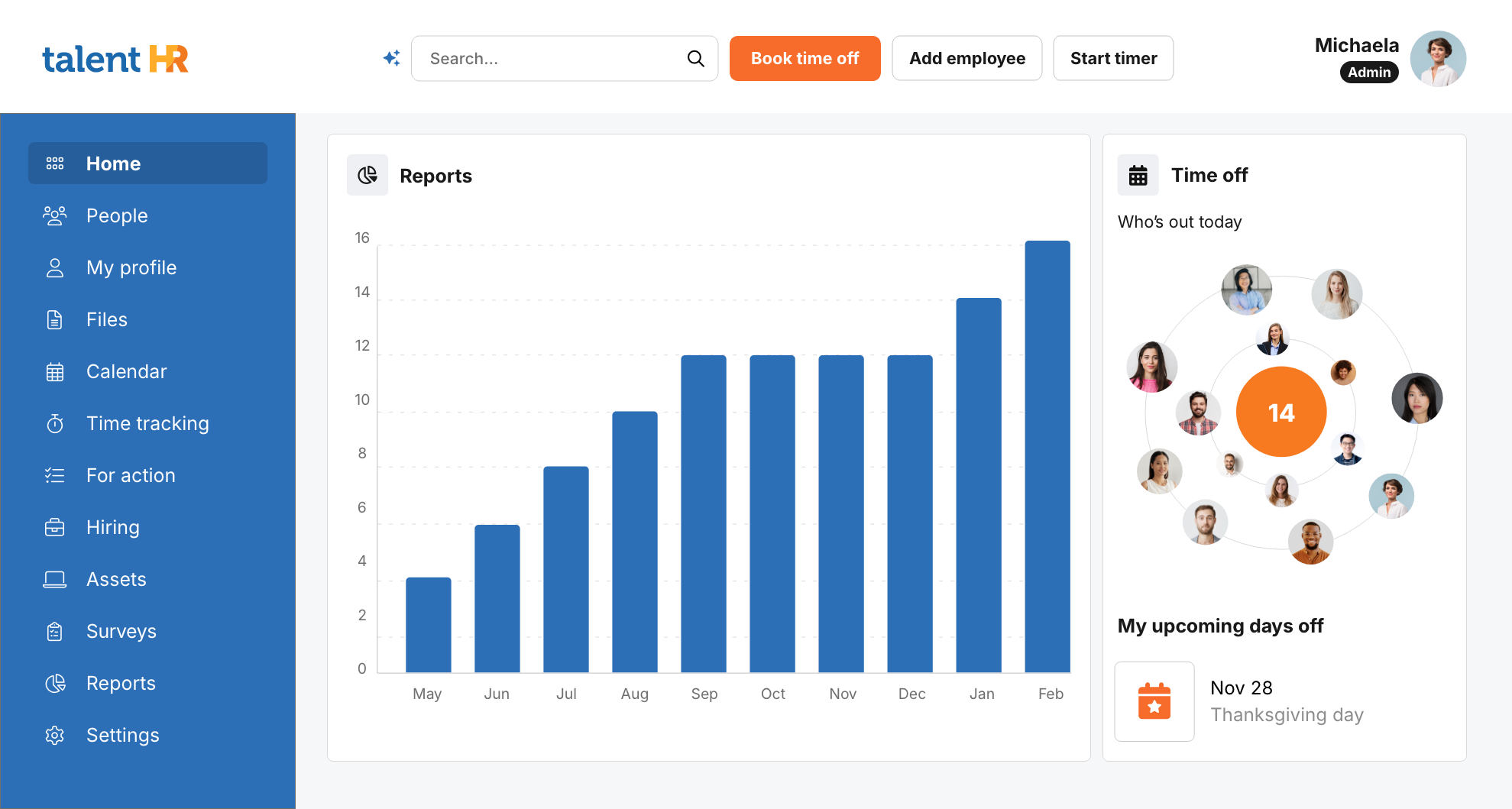
1. TalentHR (free for up to 10 users)
TalentHR leads the list because it is free to start, and you can use it right now. The free version, available across a web platform and mobile app, covers the core HR tools for up to 10 users, with no time limit and no credit card. The core stack on the free tier includes the employee database, time off tracking, file management, reports and analytics, onboarding automation, and applicant tracking.
Of course, there are paid plans as well. The reason for pointing them out is so the reader knows what an upgrade would cost in the future, if it ever becomes necessary. Performance management, time tracking, employee surveys, document signing, and custom fields sit on the paid tiers. The pricing page lays all of this out, so any company can make the decision with full information, and make it fast, without getting dizzy doing software shopping.
The upgrade trigger is straightforward. Once the team passes 10 active users, a paid plan becomes necessary, or the moment a feature like performance reviews becomes a must-have. The paid plans start at a 15-user minimum, so a move off the free tier jumps the billed seats from 10 to at least 15.
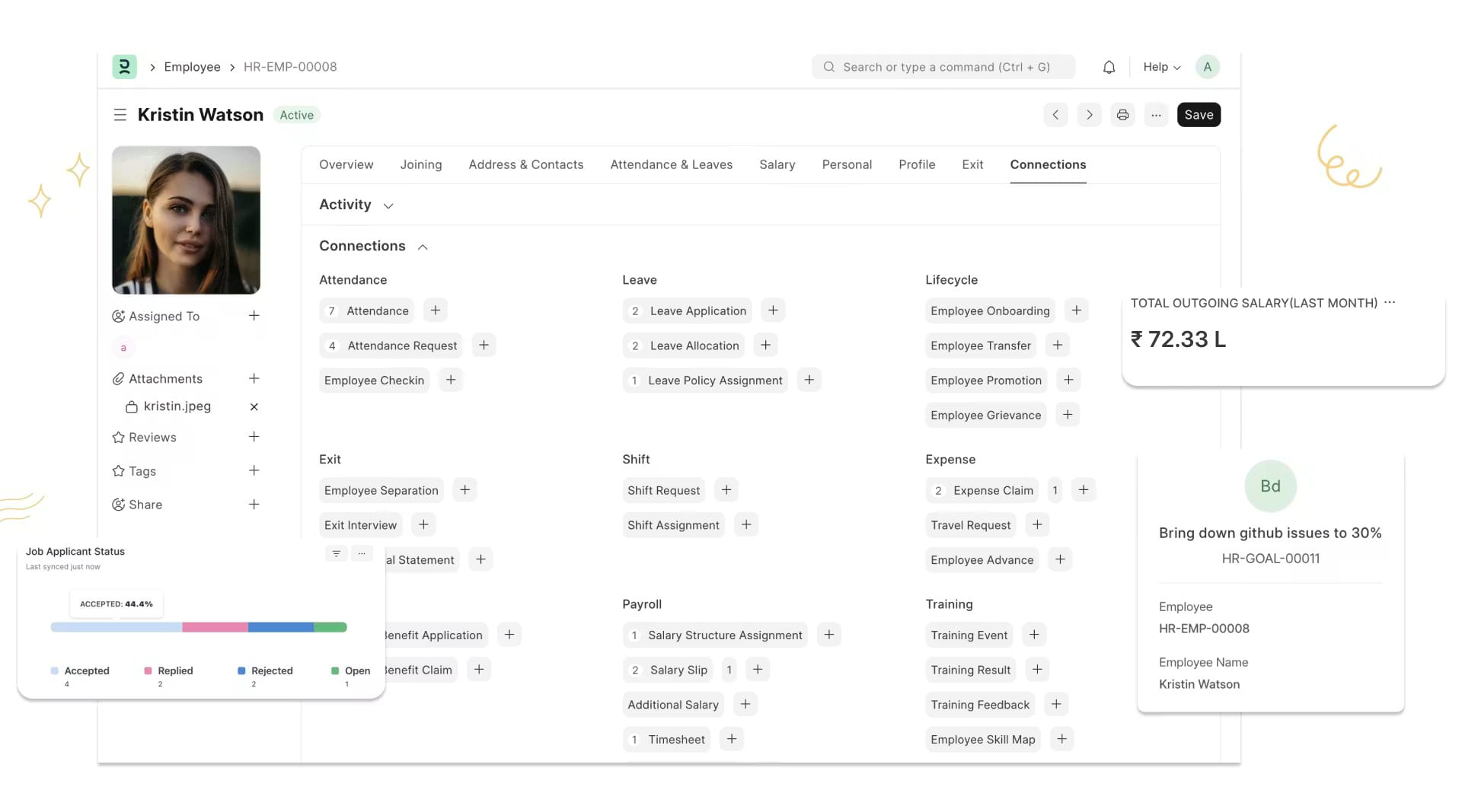
2. Frappe HR (free open source, self-hosted)
Frappe HR is free and open source under the GPL-3.0 license, and the project on GitHub is actively maintained, with a release dated June 2026. The self-host route incurs no license fees. The catch is that self-hosting costs money in another way. The company has to pay for a server and run the software on it.
For the fastest path, a platform-as-a-service host plus a CLI coding assistant to help with the setup is one option. On a host like that, the platform-as-a-service alone runs around $10 a month for a small, always-on instance. Even more conveniently, the managed Frappe Cloud service starts at $5 a month. So the software is free, but the company has to account for hosting costs. Everything has to run on some computer, and someone has to keep it running.
There are even cheaper options. For example, having a self-managed VPS (virtual private server) to run your HR software is reasonable, and cheap virtual private servers start at less than $10 a month. But a word or warning below.
Related: Why we can't recommend a VPS for your HR Software
The aim of this article is to propose something non-technical, something anyone can deploy and use, that is also cheap, and does not include the liability of a data leak. This means it's contrary to the purpose of this article to recommend a VPS as a go-to solution solely because of its price tag. We just can’t.
Going for a VPS to host your open-source HR software comes with security risks to consider, including the risk of the server being compromised and used by a botnet to send spam, as well as the risk of private employee data being exposed.
Without strong security controls—such as a zero trust security approach that strictly controls access to sensitive data—managing access risks and server vulnerabilities requires specialized expertise. A data breach could also affect your company’s ability to comply with data privacy regulations or provide the audit trails those regulations require, causing the consequences to escalate.
So, while renting a VPS might cost $10 or even less, the associated risks and liabilities can quickly compound, turning it into an expensive decision.
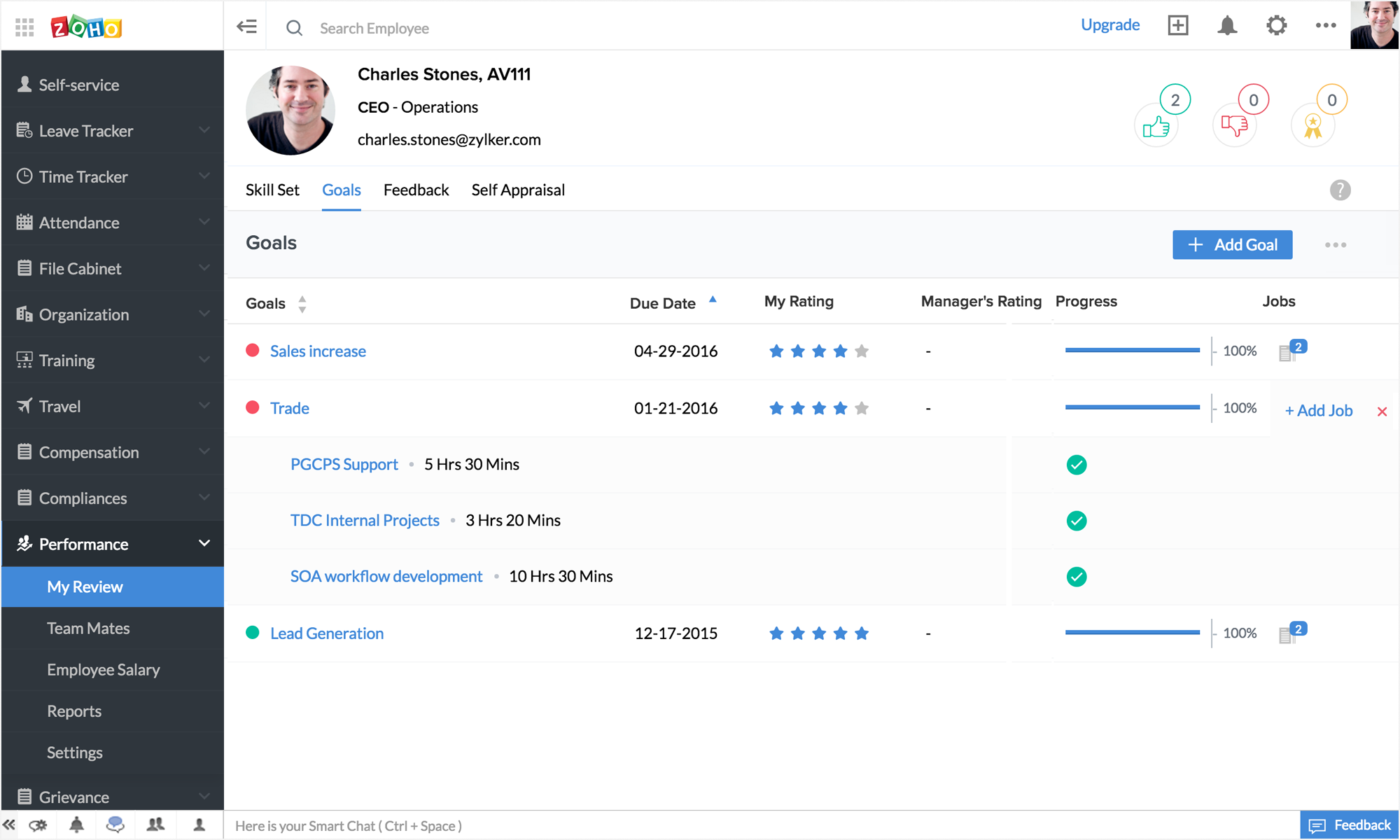
3. Zoho People (free for up to 5 users)
Zoho People offers a forever-free edition for up to 5 users, with no credit card required. The free plan covers the basics: the employee database, leave management, employee self-service, basic HR reporting, and the mobile app. The limits worth knowing are 1 admin and 250 MB of storage, with integrations routed through Zapier. The paid tiers open up the full HRIS.
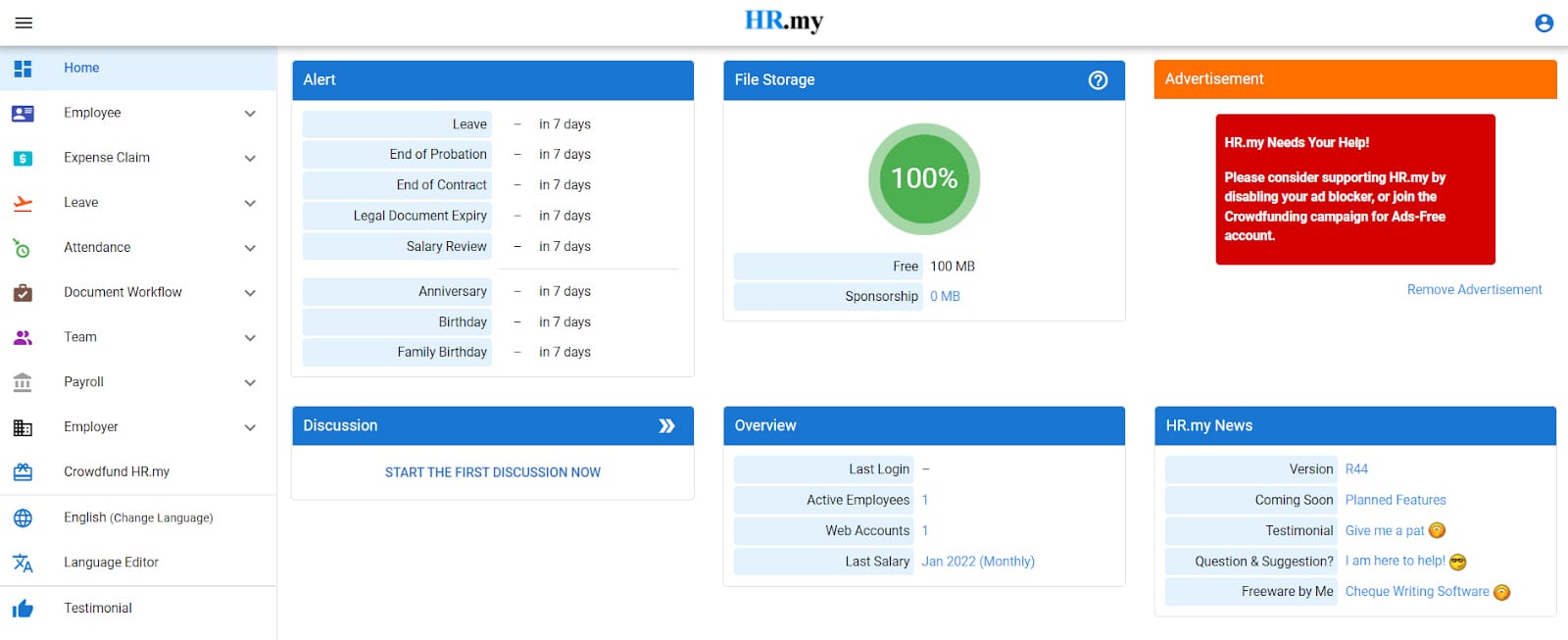
4. HR.my (free for unlimited users)
HR.my states it plainly on its own site: it is free, forever, with no per-head pricing. The free tool has no user or storage limits and covers payroll, leave, time clock and attendance, expense claims, and document workflow. Its user community funds it, which keeps it free. The trade-off is that a single-developer, community-funded project comes without a formal support contract.
What Is the Difference Between Free and Freemium HR Software?
Freemium means a real free plan exists, with serious limits that push you toward paid plans the moment your needs grow. Bitrix24 is freemium. Deel has now dropped its free plan.
Deel HR (no longer free in 2026)
Deel (included in the original version of this blog post, published in 2024) used to offer a free HR plan. This is why it still shows up on so many free software lists. In 2026, however, that has changed. Deel's own pricing page now leads with Core HR at 5 dollars per employee per month. The often-quoted free limit of up to 200 employees traces to third-party write-ups, and Deel's official page lists no free plan at all.
Bitrix24 (free plan, limited HR tools)
Bitrix24 (also mentioned in the original blog post) has a free plan that never expires. The catch is the limits. The official pricing page now describes the free plan as 100 percent free for 1 to 2 users, correcting the earlier, widely repeated claim of unlimited free users. The dedicated HR tools, such as employee-hours tracking, are available on the Professional plan and above. So for genuine HR use, the free plan offers little beyond a basic directory and communication setup.
What Is the Best Free HR Tool That Is Open Source?
Open-source HR tools are free to license and run, and they ask for technical effort in return. Frappe HR, covered above, is the strongest of them in 2026.
OrangeHRM Starter (free open source, self-hosted)
The free open-source edition of OrangeHRM, now branded OrangeHRM Starter, still exists in 2026. It is GPL-licensed and self-hostable, so the license is free and the company pays only for hosting. As with Frappe HR, a small host runs a few dollars a month, with the same security and liability caveats a self-managed server brings.
One tool to leave off the list is Sentrifugo. It is free and open-source, but the project has had no source code updates since its last release in April 2017. An unmaintained HR tool means no security patches, which is tough to recommend when handling employee data.
Free Trials (So, Not Free): Tools the Updated Guide Demotes
These tools market a free entry point, but the hosted product is a trial and does not represent a free plan. They do not belong in the main free list, so here is what they cost once the trial ends.
OrangeHRM's hosted Advanced edition runs a 30-day free trial, after which a product expert contacts you to quote a per-employee price. TimeTrex has a genuinely free, self-hosted Community Edition. Its hosted Professional plan, though, is a 30-day trial that lands around 50 dollars a month for up to 10 users once it converts. BambooHR has no free plan at all. It offers a free trial, and its pricing is quote-based, so the company has to speak with sales to figure out the price.
What Changed for Free HR Software in 2025 and 2026?
Free tiers have been tightening as vendors push to monetize. Two patterns stand out when comparing the tools side by side.
The first pattern is the squeeze on free tiers. They look a little more limited each year, designed more for conversion than for use. Part of a free trial has always been conversion. What is new is how hard some vendors squeeze the core capabilities small businesses need, as if these were enterprise transactions, which they are not.
The second pattern is AI features behind a paywall. Some tools have slapped an AI-agent label on what looks like a language model hosted on their server to answer questions, and they try to monetize from it. These AI features sit behind a paywall, when market expectations in 2026 would treat them almost as a baseline. Often, it is unclear what the company gets in exchange. Is it an assistant, or is it an agent? Looked at closely, the offering does not always deliver what the label promises. The ambiguity of each term is used to stick a promotional label on the feature and publicize it.
Try the Best Free HR Software for Small Businesses
The best free HR software for small businesses is the one a company can use right now, with full clarity on what an upgrade would bring later. TalentHR is one such tool. It is free, and you can use it right now. It has premium plans, and you can see exactly what each one includes, so the upgrade path is clear in advance if the company ever needs it. You can get started now, and meanwhile, review the pricing page to see exactly what comes free and what comes next.