
In 2025, the best online HRMS is TalentHR. TalentHR is an all-around HR solution with which HR reps and owners can hire (it comes with an ATS), onboard, offboard, get people analytics, or even offer self-served PTO to their workforce. Since it's a SaaS solution, owners can set it up in a few clicks.
In this article, we compare the best online HRMS software in 2025 so that it's clear why TalentHR wins. We’ll focus on what truly matters: features, scalability, and user experience. Whether you’re a growing startup or a mid-sized enterprise, you’ll find practical insights to help you choose a platform that simplifies HR strategy and supports your workforce's motivation.
Why HRMS matters so much in 2025
Human Resource Management Systems have become the backbone of modern HR operations and a core tool for HR professionals leading today’s organizations. These platforms go well beyond storing HR data. They automate payroll and benefits administration, track employee performance management, support employee development, and simplify onboarding, while keeping teams connected no matter where they work. For many HR departments, an HRMS now represents the foundation of effective human capital management, as it guarantees consistency across the entire employee lifecycle.
The demand for online HRMS solutions has grown exponentially ever since companies of all sizes embrace digital transformation. Cloud-based systems let HR leaders and HR personnel manage workforce management tasks like attendance management, benefits administration, and compensation management through a single, secure dashboard accessible from anywhere.
On top of this, by managing core HR functions such as time tracking, benefits programs, and training oversight through dedicated HRMS portals, businesses gain deep insights that help improve workforce productivity and optimize decision-making.
What Is an Online HRMS?
A Human Resource Management System (HRMS) is an all-in-one software that helps companies manage their people, processes, and policies in one place. Instead of juggling spreadsheets or disconnected tools, an HRMS system centralizes all important functions so HR teams can focus on strategy instead of paperwork.
Online (cloud-based) HRMS platforms differ from traditional on-premise systems in a key way: they run on the cloud. That means there’s no need for local servers or complex installations. Your data is stored securely online and accessible anytime, anywhere. Cloud-based HRMS tools also update automatically in a way that secures compliance and new features without downtime or IT maintenance.
Core HRMS functions typically include employee data management, payroll processing, leave and attendance tracking, performance evaluations, and reporting and analytics. Many modern systems also add recruiting (in some cases, even powered with AI), onboarding, and learning modules that can track employee training for a complete employee lifecycle experience.
For today’s organizations, a solid HRMS helps make HR work more efficient, compliant, and people-focused. With built-in automation and analytics, it saves time on repetitive tasks and turns data into insights that drive smarter decisions. According to SHRM, companies that use more HR technology and analytics, which are signs of higher HR maturity, see stronger results: 75% of high-maturity HR teams grew revenue in the past two years, and each step up in maturity brings about US $62,000 more revenue per employee, along with lower turnover and higher engagement.
Manufacturing HR Software: 6 Tips to Manage People, Assets, and Safety →
Key Features to Look for in 2025 Human Resource Management Systems
The best HRMS software in 2025 combines automation, analytics, and accessibility to help HR teams work smarter and faster. Here are the key features to prioritize when choosing your platform:
- Cloud-based accessibility and mobile functionality: Your HR system should work wherever your people do. A cloud-based HRMS lets teams access data securely from any device, while mobile apps let employees request time off, view payslips, or update information on the go.
- Streamlined integrations: Look for systems that integrate with your existing tools, such as payroll software, applicant tracking systems (ATS), and performance management platforms. Integrations reduce manual data entry and guarantee a single source of truth across all HR functions. Some online HRMS don't even require these integrations since they have the solutions built-in (e.g. some come with an ATS.)
- AI and automation in HR workflows: Modern HRMS tools use artificial intelligence to automate repetitive tasks like onboarding, employee attendance tracking, and employee feedback collection. Automation saves time and also minimizes human error, while also improving the employee experience.
- Data security, compliance, and scalability: As regulations tighten, data protection is non-negotiable. Choose platforms with robust encryption, GDPR compliance, and role-based access controls. Scalability matters too. Your HRMS should easily grow with your team and support future business needs.
- Employee Self-Service (ESS) capabilities: Let employees manage their own data. ESS portals let staff handle personal details, benefits, and leave requests without HR intervention.
The 3 Best Online HRMS Software in 2025
With hundreds of HR platforms available, finding the right ones that are worth it can feel overwhelming. To make your search easier, we’ve rounded up the best online HRMS software in 2025. These are tools that combine automation, usability, and scalability to simplify people management:
1. TalentHR
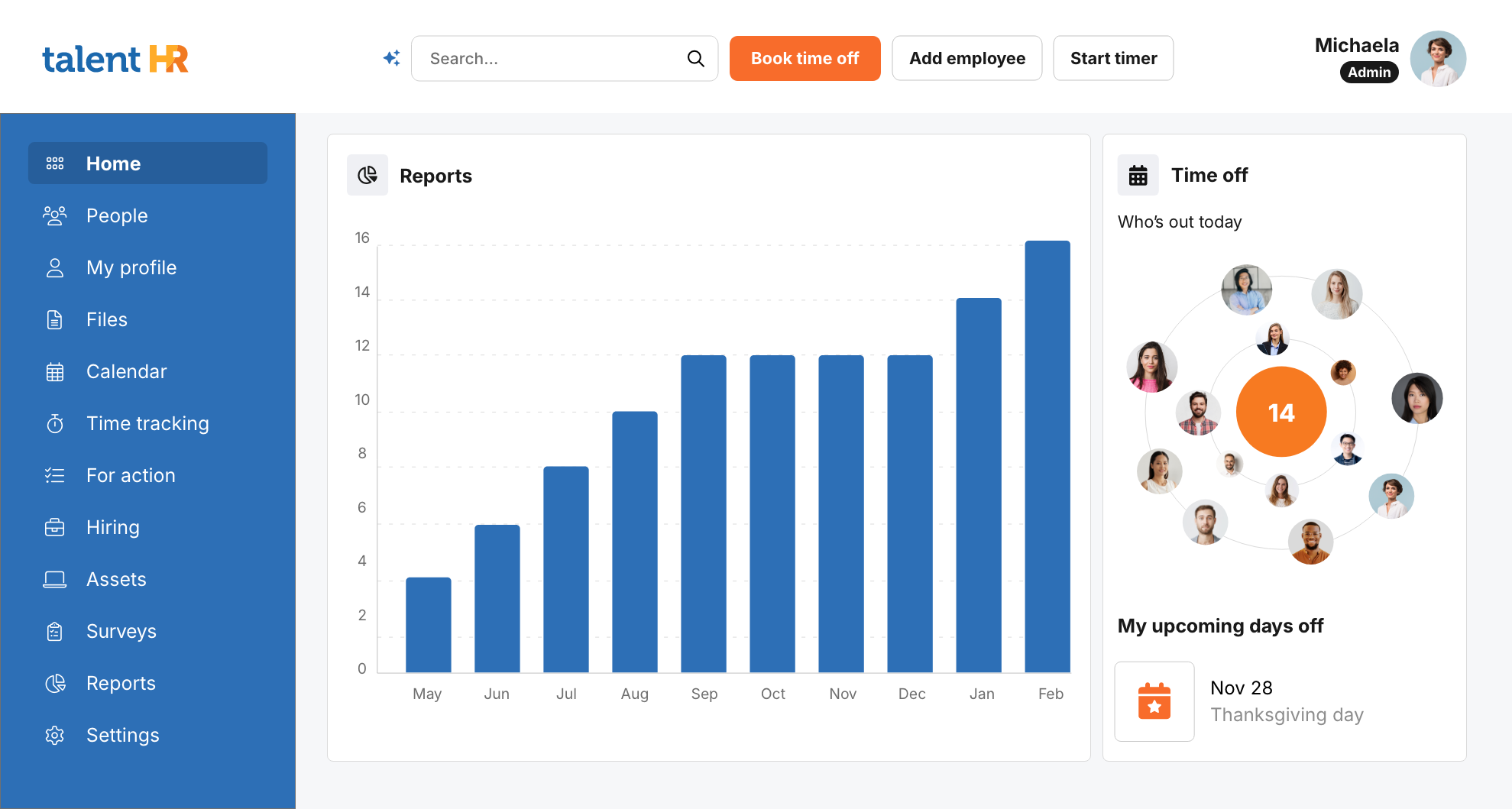
TalentHR is a modern, cloud-based HRMS designed to help small and mid-sized teams handle HR tasks without the complexity of legacy software. Its clean interface and intuitive design make it easy to manage employee data, track time off, onboard new hires, and store essential documents (all from one centralized dashboard). It’s a practical and highly flexible solution for growing companies that need robust tools but not heavy systems.
Top features
TalentHR is a Human Resources Information System (HRIS) that covers the fundamentals (employee records, absence tracking, and onboarding workflows) while adding thoughtful extras that make everyday HR operations more efficient. Its built-in document management module supports e-signatures for contracts and policy sign-offs in a way that helps teams stay organized and compliant. The platform also connects with thousands of popular apps and offers automated workflows and cross-tool visibility.
Other standout capabilities include:
- Centralized employee database and organization charts
- A PTO tracker with automated approvals
- Onboarding workflows for fast employee integration
- Built-in document management and e-signature tools
- AI-driven candidate scoring and CV summaries to simplify recruitment
- AI survey generator for engagement and feedback collection
- AI HR Assistant (Beta) that answers HR and company FAQs in any language
- GDPR-compliant data protection and regular feature updates
Ideal for: Startups and small businesses that want an affordable, all-in-one HR platform that’s quick to set up and effortless to manage. TalentHR is especially helpful for founders, HR leads, and operations managers who handle many roles at once and need a tool that saves time, automates admin work, and keeps people management simple without sacrificing quality.
Pricing: TalentHR offers one of the most generous entry points in the market, a free plan for up to 10 users, available indefinitely. All new accounts include a 14-day trial of premium features that gives teams room to explore advanced capabilities before upgrading.
Why it stands out: What makes TalentHR distinctive is how it blends simplicity, automation, and accessibility. It’s fast to set up, easy to navigate, and capable of scaling as your team grows. With GDPR-compliant data practices, regular feature updates, AI-powered tools and transparent pricing, TalentHR has quickly become a go-to choice for small teams that want enterprise-level efficiency without the enterprise-level complexity.
2. Deel
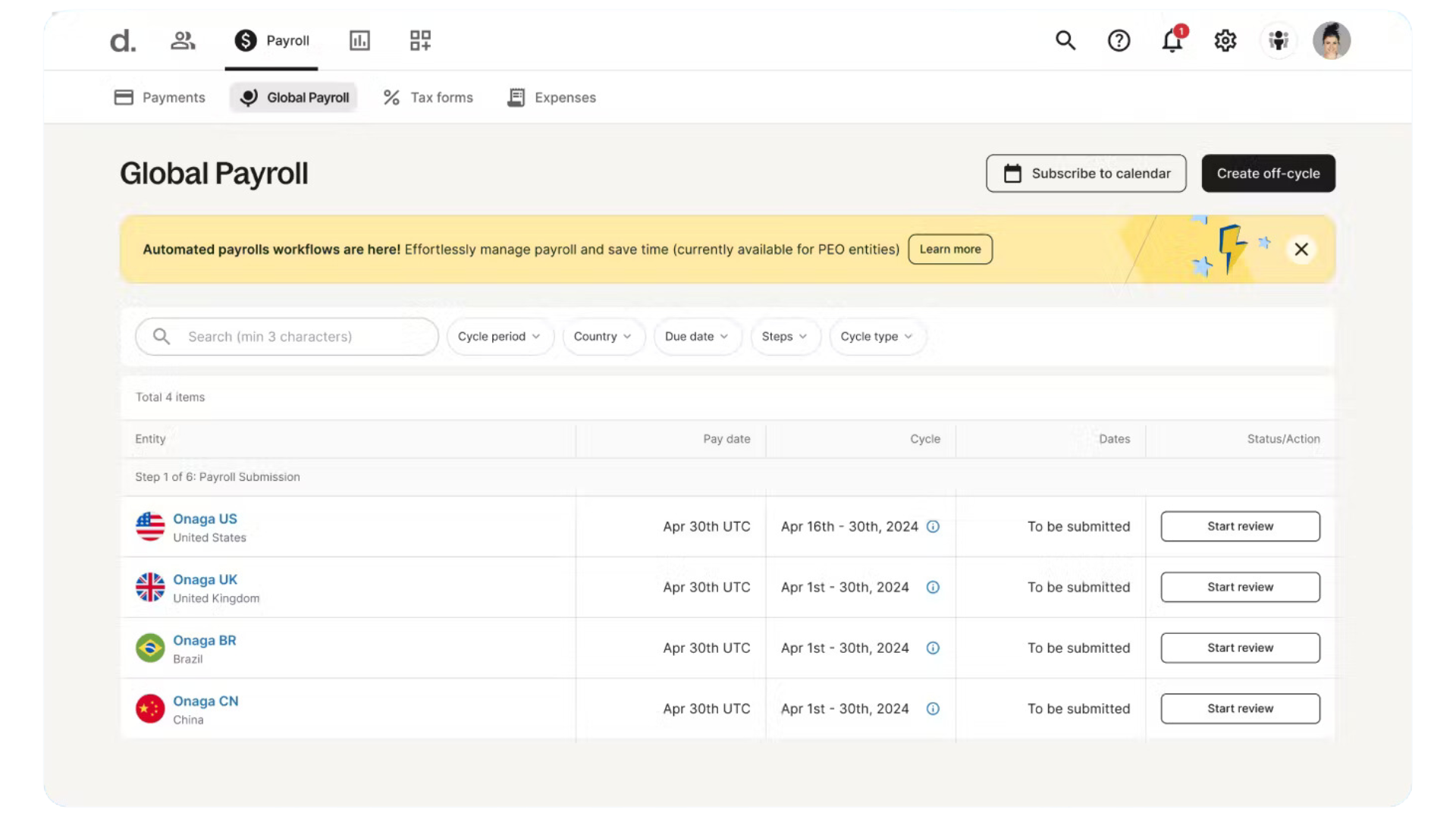
Deel is a global HR and payroll platform built for companies that hire and manage international or remote teams. It brings together tools for global hiring, onboarding, payroll, benefits, and compliance across 100+ countries, all within one cloud-based system. Deel helps organizations scale beyond borders while staying fully compliant with local labor laws.
Top features
Deel’s strength lies in its global coverage and compliance infrastructure. The platform lets you hire employees and contractors abroad without opening legal entities, thanks to its Employer of Record (EOR) network.
Other standout capabilities include:
- Automated international payroll with local tax calculations and filings
- Contractor management and Contractor of Record services
- Localized contracts that meet region-specific legal standards
- Deel Compliance Hub for real-time regulatory updates and risk alerts
- Integrations with finance tools like Xero and QuickBooks
- GDPR, SOC 2, and ISO 27001 compliance
Ideal for: Companies with distributed or remote teams, especially those operating across multiple countries or managing a mix of employees and contractors
Pricing
- Contractor Management: from $49 per contractor / month
- Contractor of Record: from $325 per contractor / month
- Global Payroll: from $29 per employee / month
- Employer of Record (EOR): from $599 per employee / month
Why it stands out: Deel stands out as one of the few platforms that truly handles global HR end-to-end. Its ability to keep companies compliant across 100+ jurisdictions makes it a go-to for organizations scaling internationally. However, its pricing can be steep for early-stage startups.
3. HiBob
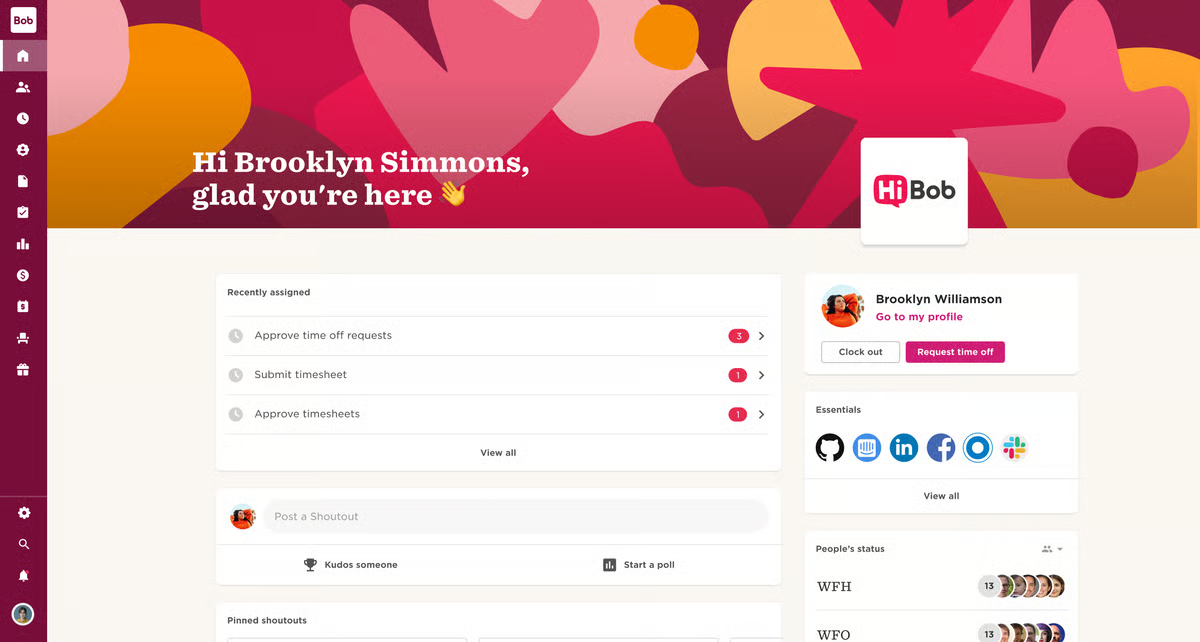
HiBob, often referred to as Bob, is an HR management platform aimed at mid-sized companies and growing startups. It consolidates everyday HR processes (such as onboarding, time-off requests, performance reviews, and compensation tracking) into one organized system. The platform’s layout is basic, and its workflows can be adjusted to fit each company’s internal structure or approval process, which makes it suitable for distributed or hybrid teams.
Top features: HiBob’s flexibility is its main strength. HR teams can customize review cycles, policies, and dashboards instead of following preset templates.
Main features include:
- Core HR database with employee self-service access
- Onboarding and offboarding task management
- Configurable performance and compensation tracking
- Built-in tools for employee engagement, surveys, and feedback
- Reporting and analytics on headcount and workforce trends
- Payroll Hub supporting US and UK payroll operations
- Integrations with Slack, Microsoft Teams, Google Workspace, and other tools
Ideal for: Mid-sized companies that have moved beyond basic HR but aren’t ready for enterprise-scale systems.
Pricing: HiBob does not publish standard pricing. Costs depend on team size, modules selected, and location, so companies must request a quote.
Why it stands out: HiBob focuses on giving HR teams a system they can shape to their processes rather than the other way around. Overall, it’s a solid choice for scaling companies that need a versatile HR platform.
Open-Source HRMS vs Freemium HRIS: Features, Costs & Scalability Compared →
How to Choose the Right HRMS for Your Business
With so many HR platforms available, the best choice depends less on who offers the most features and more on what your team actually needs. Here’s a simple framework to guide your selection process:
Step 1: Identify your must-have features
Start by mapping out your HR priorities. Do you need payroll and compliance management, or is performance tracking and employee engagement more pressing? Make a list of essentials (such as attendance tracking, document storage, or reporting) so you can focus on platforms that truly match your workflow.
Step 2: Evaluate scalability and integrations
Your HRMS should be able to grow with your business. Look for systems that integrate tightly with tools you already use (like accounting, ATS, or project management software) and can scale as your headcount increases. This prevents having to switch systems later.
Step 3: Consider pricing, setup, and support
Beyond subscription costs, think about how quickly your team can start using the system and what kind of help you’ll get along the way. Some platforms offer attractive prices but require extra fees for setup or onboarding. Look for transparent and accessible pricing, straightforward implementation, and accessible support (ideally with a setup that’s simple enough for your team to handle without external consultants).
Step 4: Request a demo and test usability
Finally, don’t skip the demo. Involve HR team members or managers who will use the software daily and gather their feedback on navigation, customization, and reporting. A robust free trial, like TalentHR’s, often reveals more than a long feature list.
Try Online HRMS Software With a Few Clicks
Online HRMS software that introduces more automation and AI features is set to become a lasting competitive advantage. As it handles repetitive processes like onboarding, document management, and compliance tracking, HRMS platforms free up time for HR teams to focus on strategy, culture, and retention.
Also, accessible software (both affordable and easy to set up) will make a difference for owners and HR reps alike. Online HRMS systems that gather all these characteristics are a good choice in 2025 and are slated to still be a good choice a few years from now.
Try TalentHR for free now and get an online HRMS up and running with just a few clicks.
Online HRMS Software FAQs
Q: What is the difference between HRMS, HRIS, and HCM?
A: All three manage people data, but their focus differs. HRIS mainly stores employee information like records and payroll. HCM adds talent management tools for hiring, development, and performance. HRMS combines both, offering a complete system for all core HR tasks in one place.
Q: Is cloud-based HRMS software secure?
A: Yes. Most cloud HR systems use strong data encryption and follow global standards like GDPR or SOC 2. They’re updated regularly and often more secure than locally installed software.
Q: Which is the best HRMS for small businesses in 2025?
A: It depends on what you need. TalentHR is great for small teams because it’s simple and affordable. Other good options offer more complex tools as your company becomes a big enterprise.
Q: How much does HRMS software typically cost?
A: Prices vary by plan and features. Basic systems can start around $2–$10 per user each month, while more advanced global platforms can cost $50 or more. Some providers also offer free trials or plans for smaller teams.
<span id="banner-img-3" style="display: none"></span>