
HR teams invest time in templates, frameworks, and rollout meetings, but a few months later goals are rarely referenced in daily work. Managers make decisions based on urgency, employees focus on what’s immediately in front of them, and goals resurface only during review cycles.
That’s when goal setting starts to lose value. New goals get added because they sound reasonable in the moment, while older, well-defined goals quietly fade. Teams stop returning to the goals that were meant to anchor priorities, and the “real” goals become whatever is most pressing that week.
Why employee goals lose relevance
In practice, goals usually drift for a few predictable reasons.
They’re written broadly to allow flexibility, which makes them hard to act on. They’re set annually, even though priorities shift quarter by quarter. Work that depends on multiple people is captured as individual ownership. Progress lives in annual presentations, kick-off team meetings, or memory rather than somewhere visible.
None of this is unusual. It’s what happens when goals sit outside the flow of work instead of evolving with it.
When goals aren’t revisited often and with clarity, teams don’t adjust them—they ignore them. Over time, goals stop shaping decisions and start feeling disconnected from day-to-day reality.
What makes employee goals worth keeping
Useful goals do one thing well: they make expectations clear right now.
That requires goals to be:
- specific enough to guide day-to-day decisions
- visible enough to support conversations
- flexible enough to be revised without losing intent
This doesn’t mean constant rewriting. It means treating goals as working agreements that are reviewed and clarified as conditions change (especially at the quarterly level).
Setting targets that don’t lose meaning
Goals that describe effort instead of outcomes are the first to become irrelevant.
“Improve collaboration” or “support growth” may reflect good intent, but they don’t help managers or employees decide what to prioritize when time is limited.
Stronger goals describe the result you expect to see. Even when outcomes are qualitative, there should be a clear signal that indicates progress or completion. The aim isn’t rigidity, it’s shared understanding.
A simple test HR teams can use: if someone new stepped into the role mid-quarter, would they understand what success looks like from the goal alone?
Using milestones to keep goals active
Large goals tend to disappear between check-ins because they offer no near-term signal.
Milestones solve that by breaking goals into smaller steps that can be reviewed, adjusted, or reprioritized as work unfolds. They create momentum early and surface problems before they become end-of-cycle issues.
Milestones also make quarterly goal reviews more productive. Instead of debating whether a goal still makes sense, teams can look at what’s been completed, what’s stalled, and what needs to change next.
Making shared ownership explicit
Many outcomes depend on collaboration, even if goals are written as individual responsibility.
When shared work is treated as individual ownership, accountability becomes unclear and alignment suffers. Shared goals make dependencies visible and reduce the prioritization friction that shows up late in cross-functional work.
Keeping check-ins focused on progress
Check-ins are where goals either resurface or quietly disappear.
When goals, milestones, and progress are current and visible, check-ins naturally focus on what has moved forward, what’s blocked, and what needs to change next. When they’re not, check-ins turn into status updates and memory reconstruction. The quality of goal setting shows up directly in the quality of these conversations.
Why goals struggle in documents and spreadsheets
Documents and spreadsheets are easy to start with and hard to maintain.
They rely on manual updates, don’t surface progress by default, and make shared ownership difficult to manage. Over time, they become something HR tracks rather than something teams use. Once progress isn’t visible without effort, goals stop influencing daily work.
30 SMART Goal Examples for Employees →
Goal setting in TalentHR
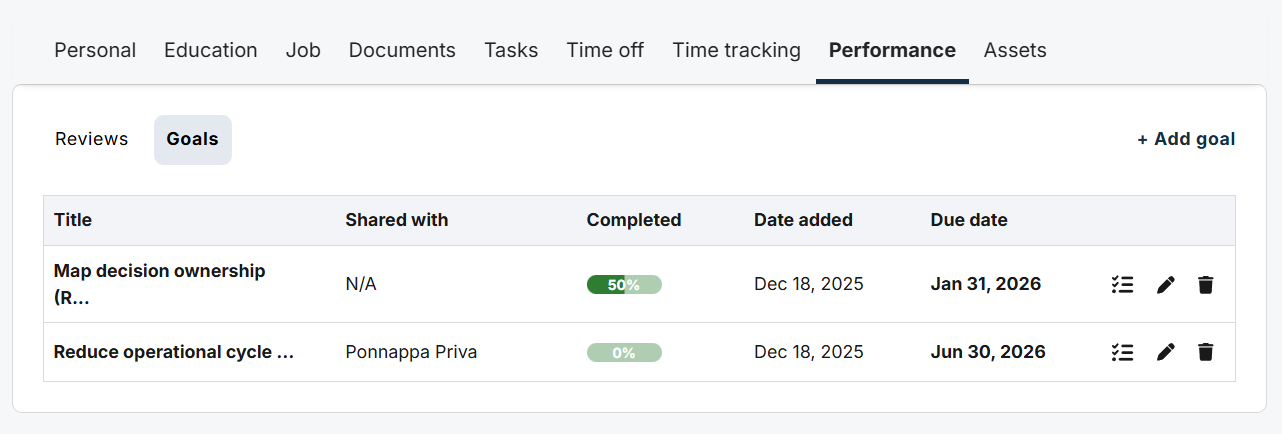
Goal setting is now available in TalentHR, designed to support goals as an ongoing part of work, rather than a once-a-year exercise.
Teams can set clear employee targets, break them into milestones, create shared goals where collaboration is required, and track progress in one place over time. This makes it easier to revisit goals, adjust them when needed, and keep them aligned with current priorities.
The feature is being released now, so teams can start the year with goals that are already structured to evolve, rather than needing to be rebuilt once work inevitably shifts.
Register today and try the new employee goal-setting feature with a 14-day Premium free trial.
 Build structure without adding steps.